
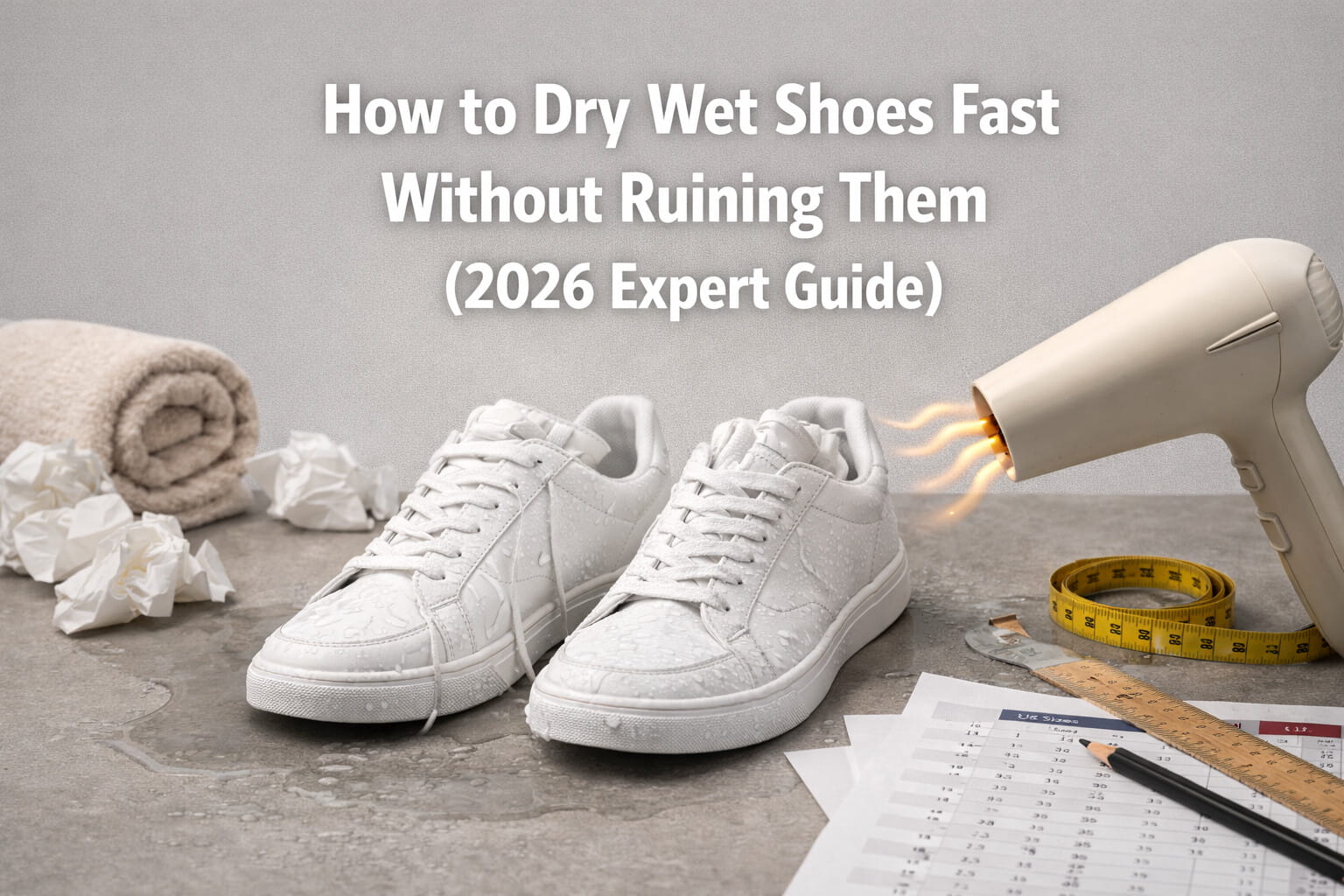
How to Dry Shoes FAST Without Ruining Them (2026 Expert Guide)
The Quickest & Safest Way to Dry Shoes
To dry wet shoes fast without damage, immediately remove the insoles and laces to maximize airflow. Stuff the shoes tightly with dry paper towels or newspaper to absorb moisture, changing the paper every hour. Place them in a well-ventilated area with a fan blowing directly on them. Avoid direct heat sources like radiators, hair dryers, or standard tumble drying cycles, as high heat warps rubber soles and dissolves bonding glue. For frequent drying, a forced-air boot dryer is the safest investment.
1. What’s the shoe made of?
2. How much time do you have?
Introduction
There is a universal sound that makes every shoe lover cringe: the squelch.
Whether you got caught in a sudden downpour in London, stepped in a slush puddle in New York, or just finished a grueling, sweaty shift, wet shoes are more than just uncomfortable. They are a ticking time bomb for your footwear.
As someone who has spent over 20 years managing a physical shoe store and handling thousands of pairs—from high-end leather boots to performance running sneakers—I can tell you that moisture is the silent killer of footwear. I’ve seen perfectly good $150 sneakers ruined because a customer tried to “speed dry” them in an oven (yes, really) or left them rotting in a damp closet.
The search intent that brought you here is clear: you want dry feet, and you want them now. But you also don’t want to destroy your shoes in the process.
In this guide, we are going to move beyond the basics. We will cover how to dry wet shoes fast, why air drying shoes correctly matters, and the truth about drying shoes in the dryer. We’ll balance speed with safety to ensure your kicks survive to walk another day.
Why This Topic Matters (And Why Experience Counts)
In my two decades of retail experience, I’ve handled returns that would make you cry. The most common tragedy? Hydrolysis. This is the chemical breakdown of the PU (Polyurethane) midsole caused by trapped moisture. When you don’t dry your shoes properly, the internal structure literally crumbles.
Most online guides simply tell you to “wait.” But in the real world—whether you are traveling, working back-to-back shifts, or training for a marathon—you don’t have 48 hours.
The Global Context:
- The Commuter: Needs work shoes dry by 7:00 AM.
- The Traveler: Has one pair of sneakers and a wet hotel room.
- The Parent: Has a kid with muddy cleats and a game tomorrow.
We need speed, but we also need to respect the materials. The methods I’m about to share are the same ones we used in the shop to salvage inventory and the same advice I’ve given to thousands of customers face-to-face.
How to Dry the Inside of Your Shoes
The inside of a shoe traps more moisture than the outside, and it’s the part most people forget. After pulling the insoles, drop 5–6 silica gel packets inside if you have them saved from old shoe boxes — they pull the last stubborn moisture out of the lining far faster than air alone. No silica gel? A sock stuffed with dry rice works in a pinch, though it’s messier and can leave grit behind. Whatever you use, leave the tongue fully open so air can actually reach the interior lining, not just the outside upper.
1. The Golden Rules of Drying (Do This First)
Before you blast them with air or heat, you must prep the patient. Skipping these steps is why shoes start to smell like a locker room.
- Remove the Insoles: Ideally, insoles retain the most water. Pull them out and dry them separately. If they are Ortholite or foam, they will dry in minutes on their own.
- Unlace Everything: Loosen the tongue. You need to open the “throat” of the shoe to let moist air escape.
- Clean the Mud: If they are muddy, hose them off now. Drying mud into the mesh creates a crust that locks moisture inside the fibers.
2. The Paper Towel / Newspaper Method (The Classic)
This is the most accessible method for everyone, from budget buyers to luxury collectors. It relies on wicking (capillary action) rather than heat.
Best For: Leather shoes, suede, and delicate sneakers.
How to do it:
- Crumple newspaper (black and white ink only—colored ink can bleed) or paper towels.
- Stuff the toe box firmly. Don’t distort the shape, but pack it tight.
- Wrap the outside of the shoe in paper/towel as well.
- Crucial Step: Change the paper every hour for the first 3 hours.
Expert Insight: “I usually recommend unprinted packing paper or paper towels over newspaper for white sneakers. I’ve seen newspaper ink transfer onto a pristine white canvas upper, which is a nightmare to clean.”
3. The Fan Method (Air Drying Shoes on Turbo)
If you don’t have a specialized shoe dryer, a standard household fan is your best friend. This method moves moisture away via evaporation without introducing dangerous heat.
Best For: Running shoes, synthetics, and mesh.
How to do it:
- Set up a table fan or floor fan on high speed.
- Make hook shapes out of heavy wire (like a coat hanger) and hook them onto the fan guard.
- Hang the shoes by the heels so the air blasts directly into the opening.
- Place a towel underneath to catch drips.
Why it works: By constantly replacing the saturated air inside the shoe with dry room-temperature air, you speed up evaporation by 300% compared to still air.
4. Using a Boot Dryer / Shoe Dryer (The Pro Investment)
If you hike, run, or live in a wet climate, a boot dryer is not a luxury; it’s a necessity. This is what we used in the back of the shop for staff footwear.
Best For: Work boots, heavy winter gear, daily commuters.
The Types:
- Thermal Convection: Silent. Uses gentle rising heat (thermal updraft) to dry shoes overnight. Safe for almost all materials.
- Forced Air: Uses a fan to blast warm air. Dries shoes in 1–2 hours.
Why I recommend them: A good shoe dryer regulates temperature strictly. It won’t get hot enough to melt glue (which usually happens around 140°F / 60°C). It also prevents bacteria growth, which is the root cause of “shoe odor.”
Check today’s best-rated boot dryers on Amazon or your local hardware listing.
5. Drying Shoes in Dryer (The Danger Zone)
Can you put shoes in the dryer? technically, yes. Should you? Proceed with extreme caution.
The Risk: The tumbling action destroys the structure of the shoe, bangs up your dryer drum, and the high heat can detach the outsole from the upper.
How to do it safely (if you absolutely must):
- Use a Drying Rack: Many modern dryers come with a rack that sits inside so the shoes don’t tumble. Use it.
- The Towel Trick: If you don’t have a rack, lace the shoes, catch the laces in the dryer door at the top so the shoes hang against the door inside the drum. They won’t tumble; they will just hang in the warm air.
- Low Heat ONLY: Never use the “High” setting. Use “Air Dry” or “Low.”
- Wrap in Towels: If you must tumble them, wrap the shoes in large towels to buffer the impact.
Material Deep-Dives: One Size Does Not Fit All
Understanding materials is what separates a footwear expert from a casual blogger.
Full-Grain Leather & Suede
- The Threat: Rapid drying causes leather to crack and shrink.
- The Fix: strictly air drying or a low-heat thermal boot dryer. Never place near a radiator or fire. Once dry, you must condition the leather to restore oils.
Synthetic Mesh (Runners)
- The Threat: Relatively low threat, but heat can warp the plastic heel counters.
- The Fix: The Fan Method. Mesh is designed to breathe; give it airflow, and it dries fast.
EVA (Croc-style or Midsoles)
- The Threat: Extreme heat (like a car dashboard or high-heat dryer) will shrink EVA foam.
- The Fix: Towel dry and air dry in the shade.
Pro-Tip Section: Retailer-Only Insights
In the shop, we often had to prep shoes that had been worn for “test runs” outside by customers trying to return them. Here are a few insider secrets:
- The Silica Gel Hoard: You know those little packets that come in shoe boxes? Don’t throw them away. We kept a bucket of them. Dropping 5-6 packets into a wet shoe is fantastic for finishing the drying process (getting that last 10% of moisture out).
- The Rice Myth: Does putting shoes in rice work? Yes, but it’s messy. Rice dust gets into the mesh and under the lining, creating grit that irritates your feet later. Stick to paper towels.
- The Rotation Rule: The only true way to prevent wet shoe damage is the “Day On, Day Off” rule. Leather needs 24 hours to expel foot perspiration. If you wear the same boots daily, they never truly dry, leading to premature rot.
Comparison Table: Drying Methods
| Method | Speed | Safety | Best For | Cost |
|---|---|---|---|---|
| Boot Dryer (Forced Air) | Fast (1-2 hrs) | High | Work boots, soaked sneakers | $$ |
| Fan Method | Medium (3-5 hrs) | Very High | Running shoes, Synthetics | Free |
| Newspaper/Paper Towel | Slow (8-12 hrs) | Very High | Leather, Suede, Delicate items | Free |
| Clothes Dryer (Tumble) | Very Fast | Low (Risk of damage) | Canvas shoes (risk of shrinkage) | High Risk |
| Radiator / Heater | Medium | Low (Fire/Warp risk) | NOT RECOMMENDED | N/A |
Common Mistakes to Avoid
- The Hair Dryer Attack: blasting a shoe with a hair dryer on “Hot” is a surefire way to melt the adhesive holding the sole to the upper. If you use a hair dryer, use the “Cool” button only.
- Sun Baking: Leaving wet leather shoes in direct, scorching sunlight bleaches the color and turns the leather into cardboard. Always dry in the shade.
- Leaving the Insoles In: This traps water between the footbed and the sole, causing mold to grow where you can’t see it until the smell becomes unbearable.
- Ignoring the “Squeak”: If your shoes squeak after drying, moisture is likely trapped in the air unit or midsole. You may need to use silica gel for 48 hours to draw it out.
how to dry shoes fast
Can I microwave my shoes to dry them? No, absolutely not. Microwaves will melt the synthetic fibers, ignite metal eyelets, and destroy the rubber compounds instantly.
Does putting shoes in the freezer kill the smell? Freezing puts bacteria in a dormant state but doesn’t kill them or remove moisture. Once they thaw, the smell and wetness return.
How long does it take for shoes to air dry? Depending on humidity and materials, passive air drying takes 24 to 48 hours. Using a fan can reduce this to 4–8 hours.
Is it safe to put Nike Air Force 1s in the dryer? It is risky. The heat can yellow the rubber soles and warp the leather. It is safer to use the fan method or a specialized shoe dryer.
Can I use a vacuum cleaner to dry shoes? Yes, putting the vacuum hose inside the shoe (on the exhaust/blow setting) works well, or sucking water out (intake) can accelerate the initial drying process.
Conclusion: Value Your Feet
Your shoes are the tires of your body. You wouldn’t drive on rotted tires, so don’t walk on rotted midsoles.
While it is tempting to throw your kicks in the dryer to save time, the risk of separation and shrinkage is rarely worth it. Whether you invest in a proper boot dryer or just master the art of the newspaper stuff, taking care of your wet shoes is actually taking care of your feet and your wallet.
Ready to upgrade your gear? Check out our top-rated moisture-wicking socks, browse the best boot dryers for 2026, or explore our waterproof footwear guide for rainy-season options.
FAQs
1. What is the fastest way to dry shoes without a dryer?
The fastest non-heat method is the “Fan Method.” Remove insoles, unlace the shoes, and hang them directly in front of a high-speed fan. Stuffing them with paper towels helps wick moisture simultaneously.
2. Will a boot dryer ruin my expensive leather boots?
No, provided you use a boot dryer with thermal convection (gentle heat) rather than high heat. These are designed specifically to dry leather slowly without cracking it.
3. How do I dry suede shoes without water spots?
Blot the suede with a microfiber towel gently to remove excess water. Stuff efficiently with paper to hold the shape and let them air dry away from heat. Once dry, use a suede brush to restore the nap.
4. Why do my shoes smell after they dry?
This is usually because they took too long to dry, allowing bacteria to multiply. To fix this, wash them with an enzyme cleaner and dry them rapidly using a fan or boot dryer next time.
5. Can I dry canvas shoes (like Converse) in the dryer?
Canvas handles heat better than leather, but the rubber soles do not. If you must, use a low heat setting and place them in a mesh bag to prevent them from banging against the drum.
6. Does newspaper ink stain the inside of shoes?
It can. For light-colored interiors or expensive sneakers, use plain unprinted packing paper or white kitchen paper towels to avoid ink transfer.
7. How often should I use a shoe dryer?
You can use a thermal (low heat) shoe dryer every day. It is excellent for hygiene, as it dries out the small amount of sweat produced daily, prolonging the life of the shoe.
8. What temperature is safe for drying shoes?
Keep the temperature below 120°F (50°C). Most quality boot dryers operate around 105°F (40°C), which is safe for adhesives and foams.
9. Can I put shoes in front of a dehumidifier?
Yes, this is an excellent method. A dehumidifier lowers the humidity in the room and pulls moisture out of the materials effectively and gently.
10. How do I dry shoes while traveling?
Remove insoles and place the shoes near the air conditioning vent (which blows dry air). Stuff them with hotel hand towels or dry socks to absorb internal moisture.
11. Does Baking Soda Help Dry Shoes Faster?
Not directly — baking soda absorbs odor and some residual dampness, but it doesn’t pull out bulk moisture the way paper towels, a fan, or silica gel do. Use it as a finishing step after the shoes are mostly dry, sprinkled inside overnight, rather than as your primary drying method.