
Youth Shoe Size Chart: What Age Range Does “Youth” Cover?
Quick Answer
- “Youth” (also called Big Kid) shoe sizing typically covers ages 8 to 12, in US sizes 3.5 to 7.
- Youth sizes are marked with a “Y” on the box, separate from toddler sizes (T or C) and adult sizes.
- Youth sizes run close to men’s sizing with little to no adjustment, while women’s sizing is usually about 2 sizes higher than the same youth size.
- Always measure foot length rather than relying on age alone, since kids this age grow at very different rates.
Youth shoe sizing, sometimes labeled “Big Kid,” typically covers children around 8 to 12 years old, in US sizes 3.5 to 7. It sits between kids sizing (toddler and little kid, roughly ages 1 to 8) and adult sizing, and it’s marked with a “Y” on the box so it isn’t confused with either one. Measuring foot length matters more than age here, since two 10 year olds can differ by more than a full size. Once a youth size reaches 6 or 7, it’s worth checking men’s and women’s shoes too, since youth sizing runs close to men’s and about 2 sizes below women’s.
What Age Range Does Youth Shoe Size Cover?
Youth shoe sizing usually covers kids from about 8 to 12 years old, though the exact cutoff depends more on foot length than birthday.
In our experience fitting thousands of children’s shoes, this is one of the most common questions we get at the counter, and it’s genuinely confusing because “youth” means something different depending on whether you’re shopping shoes or shopping clothes. On a shoe box, “Youth” (sometimes written “Big Kid” or marked with a “Y”) refers to US sizes 3.5 through 7, which is the stage right before a child moves into adult sizing. It follows toddler sizing (roughly ages 1 to 4) and little kid sizing (roughly ages 4 to 8), and it’s the last stop before men’s or women’s shoes.
A quick way to remember it: if the size tag has a “Y” after the number, like “5Y,” you’re in youth sizing.
Find the Right Youth Shoe Size
Slide to the measured foot length and we’ll match the youth size instantly, plus show the men’s and women’s equivalent.
| Youth Size | Foot (in) | Foot (cm) | UK | EU | Men’s | Women’s |
|---|
Ranges are typical, not exact. Always size to the larger foot and leave 0.4 to 0.5 inches of growing room.
Youth Shoe Size Chart (US, UK & EU)
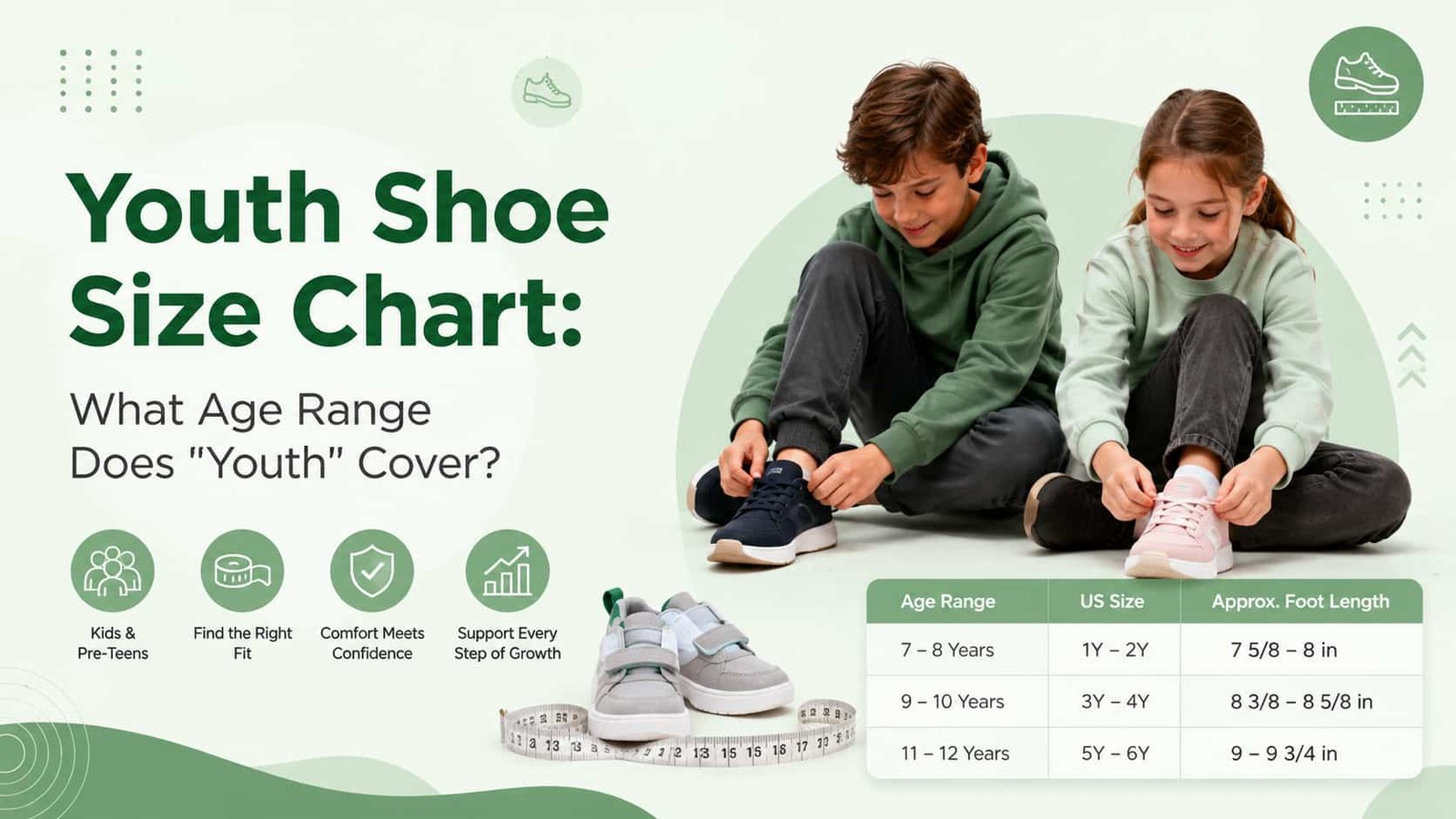
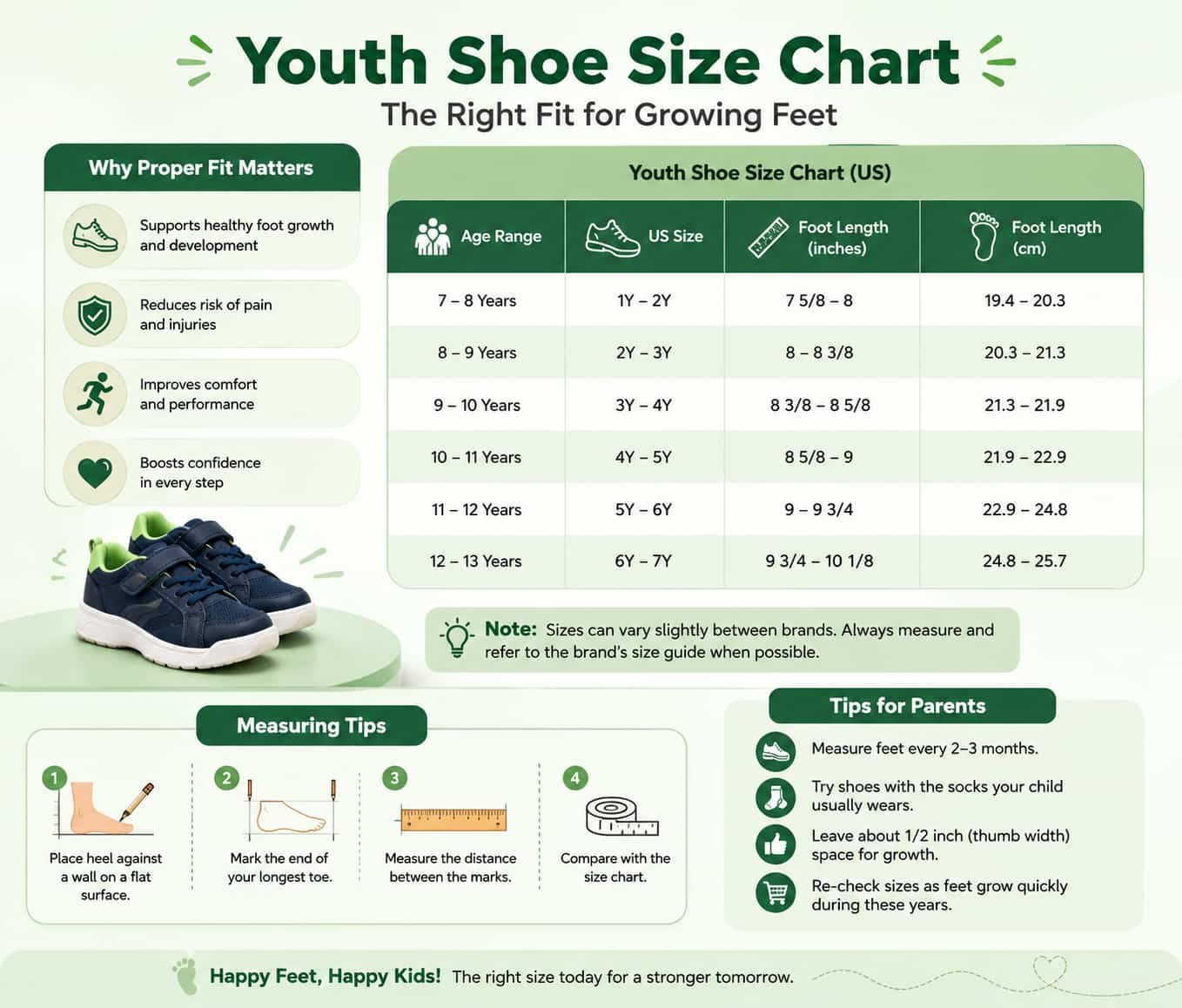
This table shows the typical foot length, US size, and UK/EU equivalents for the youth stage. Remember these are estimates. Always measure before buying, especially for a first pair in a new brand.
| US Size (Y) | Foot Length (in) | Foot Length (cm) | UK Size | EU Size |
| 3.5 | 8.9 | 22.6 | 2.5 | 35 |
| 4 | 9.1 | 23.0 | 3 | 35.5 |
| 4.5 | 9.25 | 23.5 | 3.5 | 36 |
| 5 | 9.4 | 23.9 | 4 | 36.5 |
| 5.5 | 9.6 | 24.4 | 4.5 | 37 |
| 6 | 9.75 | 24.8 | 5 | 38 |
| 6.5 | 9.9 | 25.1 | 5.5 | 38.5 |
| 7 | 10.0 | 25.4 | 6 | 39 |
If your child's foot measures below 8.9 inches, they're more likely still in little kid sizing. Our Kids Shoe Size Chart covers that earlier stage in full.
Size Snapshot
Typical Age: 10 years
Common Size: US 5 to 5.5 (Youth)
Foot Length: 9.4 to 9.6 inches
Growing Room: 0.4 to 0.5 inches
Youth vs Kids Shoe Sizes: What's the Difference?
One thing parents often miss is that "kids" isn't actually a size category on its own. It's a general term that usually covers toddler and little kid sizing together, while "youth" is its own distinct stage that follows both.
Here's the breakdown so the labels stop overlapping in your head:
- Toddler: roughly ages 1 to 4, sizes 4 to 10, marked "T" or "C"
- Little Kid: roughly ages 4 to 8, sizes 10.5 to 3
- Youth (Big Kid): roughly ages 8 to 12, sizes 3.5 to 7, marked "Y"
The numbering resets between toddler and little kid, but it flows continuously from little kid straight into youth. That's actually where we see the fewest sizing mistakes, since a little kid size 3 rolls right into a youth size 3.5 without a confusing jump. The bigger mix-ups happen when parents shop online and don't notice whether a listing says "Kids" (which could mean either toddler or little kid) or specifically "Youth."
If you want the full picture across every stage from birth through age 12, our Kids Shoe Size by Age guide lays out the entire timeline in one place.
Did You Know?
A child's foot reaches close to 90 percent of its adult length somewhere around age 10 to 12, right in the middle of the youth sizing stage. That's part of why growth can suddenly feel like it's leveling off after years of fast changes.
How to Measure Your Child's Feet for Youth Sizing
Measuring a youth-age child is usually easier than measuring a toddler, since they can stand still and even help with the process.
- Have your child stand on a piece of paper with their heel against a wall or baseboard.
- Mark the tip of the longest toe with a pencil held straight up, not at an angle.
- Measure both feet. It's common for one to be slightly longer, and you should always size to the bigger one.
- Measure again in the evening if you can, since feet swell a little by the end of the day.
- Re-measure every 4 to 6 months at this age. Growth has usually slowed from the toddler years, but it hasn't stopped.
Expert Tip
Measure with the socks your child actually wears for sports or school. After 25 years in children's footwear, we still see kids come in wearing thick athletic socks to try on a shoe they'll wear with thin ones, which throws off the whole fit.
Youth to Men's and Women's Shoe Size Conversion
Here's the good news for anyone shopping for an older kid or a small-footed adult: youth sizing connects directly to both men's and women's shoes, and once you know the pattern, it opens up a lot more options.
- Youth to Men's: Youth sizing runs very close to men's sizing with little to no adjustment. A youth size 6 is typically close to a men's 6, though it's worth trying on since youth shoes are usually built on a slightly wider last.
- Youth to Women's: Add about 2 to the youth size to estimate the women's equivalent. A youth size 5 is roughly a women's 7.
| Youth Size | Approx. Men's Size | Approx. Women's Size |
| 3.5 | 3.5 - 4 | 5.5 |
| 4 | 4 | 6 |
| 5 | 5 | 7 |
| 6 | 6 | 8 |
| 7 | 7 | 9 |
A couple of things worth knowing before relying on this table. Not every brand uses the same offset. Nike, for example, commonly uses a smaller adjustment for the youth to women's conversion than the standard "plus 2" rule most other brands use. Youth shoes also tend to run on a wider last than women's shoes, so the same converted size might feel roomier through the toe box.
Signs of a Correct Fit
A properly fitted youth shoe should check every one of these:
- About a thumb's width of space between the longest toe and the front of the shoe
- No heel slipping while walking, running, or jumping
- No red marks or pressure lines once the shoe comes off
- Toes can wiggle freely inside the shoe
- The shoe bends at the ball of the foot, not somewhere in the middle of the sole
Parent Checklist
- Measure both feet, ideally standing.
- Try shoes on with the socks they'll actually wear for that activity.
- Leave 0.4 to 0.5 inches of growing room.
- Re-check fit every 4 to 6 months at this age.
- Check for heel slip during a short walk, not just while standing still.
Signs the Shoes Are Too Small
One common issue we notice at this age is a kid not mentioning discomfort at all, simply because they've gotten used to it or assume tight shoes are normal.
- Complaints of foot pain or tiredness that show up mainly after gym class or sports
- Red marks or pressure lines visible after the shoe comes off
- Toes curling, or no gap at all at the front of the shoe
- Resistance to wearing a favorite pair that used to be worn happily
- Visible wear or a bulge at the front of the shoe from toes pressing forward
Signs the Shoes Are Too Big
Shoes that are too big cause just as many problems as shoes that are too small, especially once running and sports are involved.
- Visible heel slip while walking or running
- Shuffling instead of a normal stride
- The shoe coming loose or off entirely during active play
- Extra material bunching at the toe when you press down gently
Common Mistake
Buying a size up "so it lasts through the school year" is one of the most common mistakes we see at this age, especially with sports shoes. A loose shoe affects balance and performance, and it can cause blisters from the foot sliding forward, which usually costs more in frustration than the size-up saved in shoe budget.
Buying Guide: What Actually Matters
- Real arch and heel support. Unlike toddler and little kid shoes, youth-age kids benefit from actual structure, since they're running, jumping, and playing sports regularly.
- Breathable, durable materials. Mesh or knit uppers hold up better through daily wear and keep feet cooler during activity.
- Width, not just length. Many kids have proportionally wider feet at this age, especially if they're active. If a shoe feels tight across the widest part even at the right length, look for a wide-fit option before sizing up the whole shoe.
- Grip suited to the activity. A basketball shoe, a running shoe, and a casual sneaker have different sole patterns for a reason. Match the shoe to what it'll actually be used for.
- Room to grow, but not too much. At this age, kids are hard on shoes, so buying slightly ahead of current size can extend the life of a pair, as long as it doesn't cross into "too big."
Avoid This
Skip shoes that feel stiff right out of the box "because they'll break in eventually." We've seen many parents make this mistake with new sports shoes especially. If it doesn't flex easily at the store, it's not going to be comfortable for daily wear either.
Common Parent Mistakes
- Assuming "kids" and "youth" mean the same size range, when youth is actually its own distinct stage
- Sizing by age alone instead of measuring, even though growth rates vary a lot by this point
- Skipping the width check and focusing only on length
- Not noticing whether an online listing says "Kids" versus specifically "Youth," which leads to ordering the wrong size range entirely
- Assuming youth sizing has a hard ceiling instead of checking men's or women's shoes once sizes reach 6 or 7
FAQs
What age is youth shoe size for? Youth shoe sizing typically covers kids around 8 to 12 years old, though it depends more on foot length than exact age. Some kids move into youth sizing earlier or later depending on their individual growth rate.
Is youth the same as kids' shoe size? Not exactly. "Kids" is a general term that usually covers both toddler and little kid sizing, while "youth" (also called Big Kid) is its own distinct stage that comes after both, marked with a "Y" on the box.
Is youth shoe size the same as youth clothing size? No, and this trips up a lot of parents. Youth clothing sizes like Small, Medium, and Large follow a completely different system than youth shoe sizes, which use a numbered scale like 3.5Y to 7Y.
How do I convert youth shoe size to men's? Youth sizing runs very close to men's sizing with little to no adjustment needed. A youth size 6 is typically close to a men's 6, though youth shoes are usually built on a slightly wider last, so it's worth trying on before assuming an exact match.
How do I convert youth shoe size to women's? Add about 2 to the youth size to estimate the women's equivalent. A youth size 5 is roughly a women's 7, though the exact offset can vary slightly by brand.
What does the "Y" mean on a shoe size tag? "Y" marks a youth or big kid size, distinguishing it from toddler sizes (marked "T" or "C") and from adult sizes that sometimes reuse the same numbers. Always check for the Y before assuming a size matches across categories.
How much growing room should youth shoes have? Leave about 0.4 to 0.5 inches, roughly a thumb's width, between the longest toe and the front of the shoe. Much more than that and the heel tends to slip during activity.
How often should I measure my child's feet at this age? Every 4 to 6 months works well for most kids in the youth stage, since growth has slowed compared to the toddler years but hasn't stopped. It's smart to check again before any sports season starts.
Should I buy wide width shoes for my child? If their foot looks proportionally wide, or a standard shoe leaves red marks along the sides even at the right length, a wide-width option is worth trying before sizing up the whole shoe.
Do girls and boys use the same youth shoe sizing? Yes, youth sizing uses the same numbering for both, since it's based on foot length rather than gender. Styles and widths sometimes differ between girls' and boys' lines, but the size scale itself is shared.
Is it okay to size up so shoes last longer? Not really, especially once sports and running are involved. A shoe that's noticeably too big affects balance and can lead to blisters from the foot sliding forward inside the shoe.
When does youth sizing end and adult sizing begin? Youth sizing generally tops out around a size 7, at which point most kids can move into men's or women's shoes directly, using the conversion guidance above as a starting point.
RELATED ARTICLES
CONCLUSION
"Youth" on a shoe box simply means your child has moved past toddler and little kid sizing and is now in the stage right before adult shoes, roughly ages 8 to 12 and sizes 3.5 to 7. Measuring foot length is still the most reliable way to get the fit right, since two kids the same age can genuinely need different sizes.
Measure both feet, leave that thumb's-width of growing room, and once sizes reach 6 or 7, it's worth trying a few men's or women's styles too. For the full conversion tool across every size system, our Shoe Size Conversion Chart Calculator covers US, UK, and EU sizing in one place.