
Heel Pain When Walking: 8 Causes and How to Fix It
INTRODUCTION
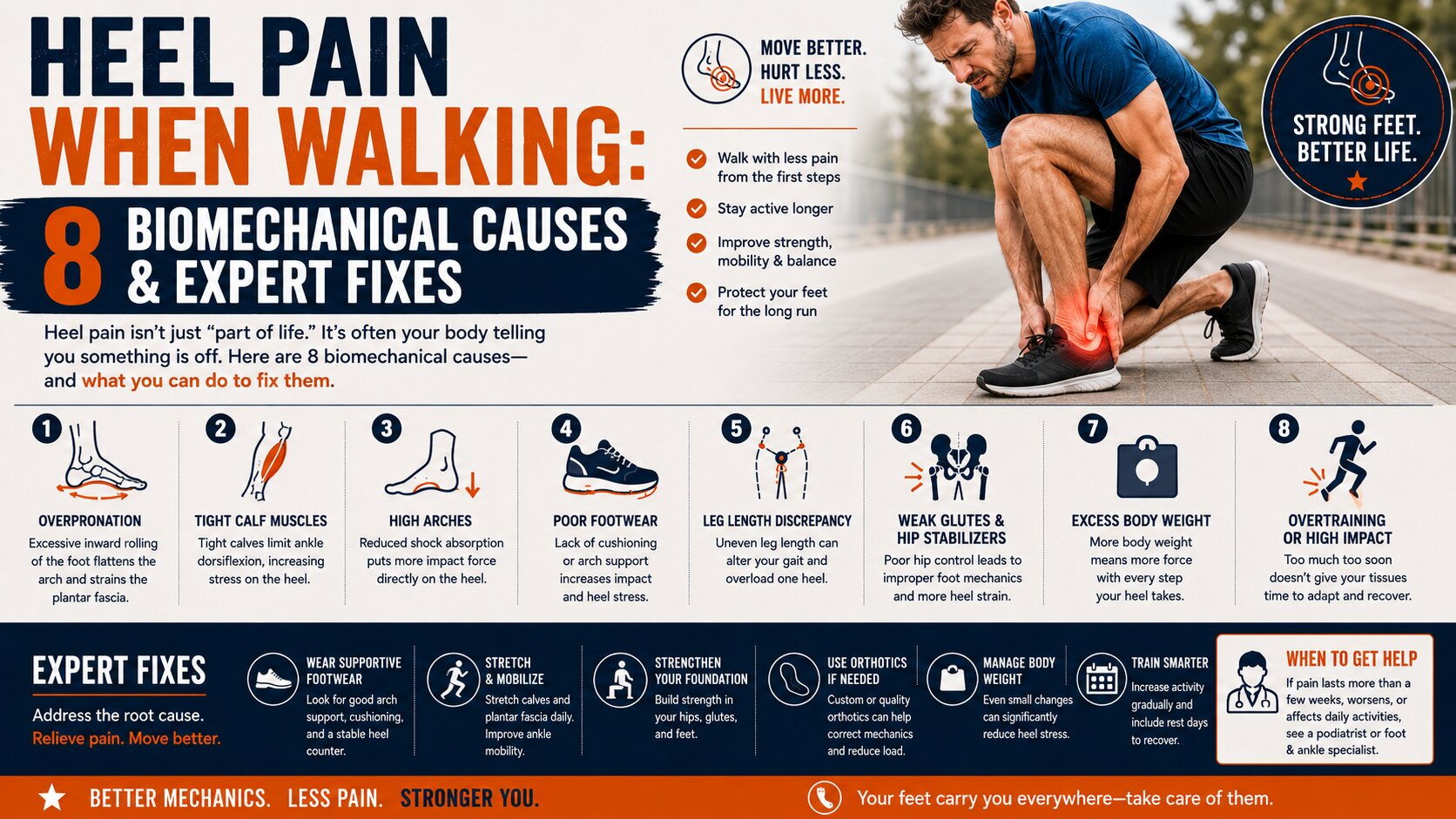
There is a fundamental difference between standing still and taking a step. When you stand, your body weight is distributed relatively evenly across both of your feet. But the moment you take a step forward, your biomechanics shift dramatically. As your front leg swings forward and your heel makes contact with the ground, a force equivalent to $1.5\text{ to }2\text{ times}$ your total body weight is loaded directly onto a single, highly concentrated point: your calcaneus (the heel bone).
If you are walking on hard, unyielding modern surfaces like concrete sidewalk, asphalt, or tile, that vertical collision happens thousands of times a day. If your foot is healthy and your shoe is structurally sound, your body absorbs this shock beautifully. But when something is structurally misaligned or your footwear is worn out, that repetitive impact turns into a deep, bone-bruising throb or a sharp, needle-like stab.
Over twenty years of fitting shoes on the retail floor, I have watched countless customers limp into my store, walking gingerly on their toes to avoid letting their heels touch the floor. They sit on my bench, exhausted from adjusting how they walk, and ask: “why do my feet hurt so intensely the second I start walking, even if they felt perfectly fine while I was sitting down?”
Many of these people have been told that their only option is to stop walking, take expensive prescription painkillers, or get cortisone injections. But as a footwear professional, I know that the vast majority of walking heel pain can be resolved by identifying the specific phase of your walking stride that triggers your pain, understanding the underlying tissue mechanics, and matching your foot to the correct physical shoe architecture.
In this comprehensive, experience-driven guide, we will analyze the precise biomechanics of walking, break down the eight real causes behind your pain, and provide you with actionable, retail-tested footwear solutions to get you walking pain-free again.
⚡ Quick Picks – Best Heel Pain Shoes 2026
- 🏆 Best Overall (Women): Skechers Work Max Cushioning Elite SR – Max cushioning + slip-resistant outsole for all-day work shifts
- 🦶 Best Arch Support: Skechers Arch Fit Arcade – Arcata – Podiatrist-certified insole, 120,000 foot scans behind the design
- 💰 Best Value Slip-On (Women): Skechers Work D’lux Walker SR – Ozema – EH-safe, slip-resistant, memory foam under $65
- 👟 Best for Men: Skechers Afterburn M. Fit Wonted – Leather upper, memory foam insole, wide-fit options
- 🏅 Best Max Cushion (Premium): Brooks Women’s Ghost Max 2 – APMA-accepted, nitrogen-infused DNA Loft v3 foam, PDAC A5500 certified
- 😴 Best Hands-Free Slip-On: Skechers Glide-Step Altus Hands Free – Heel Pillow tech + air-cooled memory foam, machine washable
- 👠 Best Casual Work Style (Women): Skechers Uno – Stand On Air – Visible air cushion midsole, stylish wedge design, moderate-to-max cushion
- 🥿 Best Professional Loafer: Clarks Women’s Cheyn Madi Pull-On – Full-grain leather, OrthoLite footbed, office-ready look
THE BIOMECHANICS OF THE WALKING GAIT CYCLE
To understand why your heel hurts when you walk, we have to look at the physical mechanics of a single step. The human walking gait cycle is divided into two main phases: the Stance Phase (when your foot is in contact with the ground, representing roughly $60\%$ of the cycle) and the Swing Phase (when your foot is in the air, representing about $40\%$).
The stance phase is where heel pain occurs, and it is divided into three distinct sub-phases:
                    [THE WALKING GAIT LOAD PATHWAY]

    Phase 1: Heel Strike ────> Phase 2: Mid-Stance ────> Phase 3: Toe-Off
    (Max collision force)      (Arch flattening /       (Windlass mechanism
    (Fat pad absorbs impact)    Pronation control)       tightens the fascia)
1. Initial Contact (Heel Strike)
This is the exact millisecond your heel makes contact with the ground. Biomechanically, your ankle is slightly dorsiflexed, and your foot is slightly supinated (tilted outward) to act as a rigid lever.
As your heel hits the hard floor, your natural fat pad—a specialized cushion of adipose tissue directly beneath your heel bone—is compressed under hydrostatic pressure to disperse the vertical shockwaves. If you are wearing a shoe with no shock-absorption properties, or if your natural fat pad has worn thin, this phase causes an intense, localized bone-bruise sensation.
2. Mid-Stance (Full Load-Bearing)
As your body weight rolls forward, your entire foot meets the ground. To adapt to the flat surface, your foot transitions from a rigid lever into a mobile shock absorber. Your arch naturally flattens slightly, and your ankle rolls inward—a process called pronation.
If your foot pronates excessively (overpronation) or if your shoe’s midsole is too soft and collapses inward, your arch drops too far. This sudden collapse puts immense, abnormal lateral traction on your plantar fascia and posterior tibial tendon, leading to sharp, burning pain along the inner border of your heel.
3. Terminal Stance to Pre-Swing (Propulsion / Toe-Off)
As you prepare to push off the ground to take your next step, your heel lifts off the floor, and your body weight shifts forward onto the ball of your foot. Biomechanically, as your big toe bends upward (dorsiflexion), it triggers the Windlass Mechanism.
The Windlass Mechanism is a structural pulley system: your plantar fascia is pulled tight around the heads of your metatarsal bones, winding like a cable around a winch. This mechanical tightening naturally pulls your heel bone closer to your toes, raising your arch and turning your foot back into a rigid, powerful lever for push-off.
If your plantar fascia is already inflamed, stiff, or torn, this sudden mechanical winding forces the tissue to stretch under high tension, causing an agonizing, ripping sensation at the inside corner of your heel.
8 REAL CAUSES OF HEEL PAIN WHEN WALKING
When people search for solutions to walking heel pain, they are often bombarded with generic diagnoses. As an experienced shoe fitter, I have learned that misidentifying your pain can lead to buying the completely wrong style of shoe, which can worsen your alignment and prolong your recovery.
Let’s break down the eight real causes of heel pain when walking so you can identify your exact issue.
                         [WALKING HEEL PAIN CAUSE MAP]

                                 Retrocalcaneal Bursitis (Back of Heel)
                                        |
                                        V
                         _______     _____
                        /       \___/     \ <-- Achilles Tendonitis (Insertion)
                       /                   \
                      /                     \ <-- Fat Pad Atrophy (Direct Center)
                     /                       \
     Front of Foot  (_________________________)
                                 |
                                 V
                      Plantar Fasciitis (Medial calcaneal tubercle)
CAUSE 1: PLANTAR FASCIITIS (THE PROPULSION TEAR)
Plantar fasciitis is the single most common cause of heel pain when walking. It is a chronic overuse injury of the thick, fibrous band of connective tissue that runs along the bottom of your foot.
The Biomechanical Trigger
While walking, your plantar fascia acts like a bowstring, holding your arch in place. If your calf muscles are tight or if your foot rolls inward excessively, the fascia is subjected to repetitive, high-velocity stretching with every single step you take. Over time, this constant traction causes microscopic tears to form near its insertion point on the medial tubercle of the calcaneus (the bottom-inside corner of your heel bone).
The Walking Pain Signature
- Location: The inside corner of the bottom of your heel.
- Sensation: A sharp, needle-like stab on your first few steps after sitting down or when waking up.
- Gait Phase: Most painful during Terminal Stance (Toe-Off), when the Windlass Mechanism is fully engaged, winding the inflamed tissue tight.
If you find yourself limping through those first agonizing steps of the day, understanding why do heels hurt in the morning is your first step toward recovery. To calm the acute inflammation before your next long walk, check out our highly effective home treatment steps on how to relieve plantar fasciitis pain fast.
CAUSE 2: ACHILLES TENDONITIS AND TENDINOSIS (THE PROPULSION PULL)
If your pain is located at the back of your heel rather than the bottom, you are likely dealing with Achilles tendonitis—an inflammation of the thick tendon that connects your calf muscles to your heel bone.
The Biomechanical Trigger
When you walk, your calf muscles contract to pull your heel upward, allowing you to lift your foot and push forward. If you walk in completely flat, zero-drop shoes or barefoot on hard surfaces, your ankle is forced to flex upward to its maximum range. This extreme upward flexion places immense, continuous mechanical strain on the Achilles tendon, leading to microscopic tearing, thickening, and inflammation.
The Walking Pain Signature
- Location: The back of the heel, either directly where the tendon inserts into the bone or about $2\text{ to }3\text{ inches}$ above it.
- Sensation: A stiff, tight, burning sensation that makes your ankle feel like a rigid, wooden board.
- Gait Phase: Most painful during Pre-Swing (Heel-Off), when your calf muscle actively contracts to pull your heel off the ground.
CAUSE 3: HEEL FAT PAD ATROPHY (THE HEEL-STRIKE BRUISE)
Many walkers over the age of forty, or heavy-set individuals who spend years working on hard concrete, develop heel pain that has nothing to do with tendon or ligament inflammation. Instead, it is a structural loss of their built-in shock absorbers.
The Biomechanical Trigger
Your heel fat pad is made of specialized fat chambers surrounded by tough, fibrous walls (septae). This pad acts like a hydraulic shock absorber, cushioning your heel bone against the ground. As we age, or due to repetitive high impacts, these fat chambers lose their elasticity, flatten out, or shift out of place. Without this natural protective barrier, your heel bone is subjected to direct, unshielded trauma with every step.
The Walking Pain Signature
- Location: The absolute center of the bottom of your heel.
- Sensation: A deep, bruised, hollow ache. It feels like you are walking barefoot directly on stone or concrete.
- Gait Phase: Most painful during Initial Contact (Heel Strike), when your foot first collides with the ground. Unlike plantar fasciitis, the pain actually worsens the further you walk.
CAUSE 4: CALCANEAL STRESS FRACTURES (THE REPETITIVE IMPACT CRACK)
If you have suddenly increased your daily walking mileage, started walking on hard asphalt to exercise, or are dealing with osteopenia, you could be facing a hairline crack in your heel bone.
The Biomechanical Trigger
Bone is a living tissue that constantly remodels itself. When you walk, the impact causes microscopic damage, which your body naturally repairs using specialized cells (osteoblasts). However, if you suddenly increase your daily step count without giving your bones time to adapt, the rate of micro-damage outpaces your body’s ability to repair it. This imbalance leads to a hairline crack—a calcaneal stress fracture.
The Walking Pain Signature
- Location: Broadly across both the medial and lateral sides of the heel bone.
- Sensation: A deep, throb that feels like it is coming from inside the bone itself.
- Gait Phase: Painful throughout the entire stance phase of walking. If you squeeze the sides of your heel bone between your thumb and fingers (the “Heel Squeeze Test”) and experience sharp pain, it is a classic sign of a stress fracture.
CAUSE 5: BAXTER’S NERVE ENTRAPMENT (THE PINCHED PATHWAY)
Baxter’s nerve entrapment is one of the most frequently misdiagnosed causes of heel pain when walking, often mistaken for typical plantar fasciitis.
The Biomechanical Trigger
The first branch of the lateral plantar nerve (often called Baxter’s nerve) runs down the inside of your ankle, takes a sharp $90^\circ$ turn, and passes directly under your heel bone. If your foot overpronates excessively, or if you have a tight, deep muscle on the inside of your arch (the abductor hallucis), this nerve can become physically pinched and compressed during walking.
The Walking Pain Signature
- Location: The bottom-inside of the heel, radiating slightly upward along the inside of your ankle or outward toward your pinky toe.
- Sensation: Burning, tingling, “pins and needles,” or a numbness that does not improve with typical stretching.
- Gait Phase: Painful during Mid-Stance to Terminal Stance, when your foot is fully loaded and your arch is compressed, pinching the nerve pathway.
CAUSE 6: RETROCALCANEAL BURSITIS (THE COLLISION FRICTION)
Directly between your Achilles tendon and your heel bone sits a tiny, fluid-filled sac called a bursa. This bursa acts as a friction-reducing cushion, allowing the tendon to glide smoothly over the bone.
The Biomechanical Trigger
If you wear stiff, rigid shoes with hard heel counters (the back wall of the shoe) that press tightly against the back of your heel, the constant friction and pressure can irritate the bursa. As you walk, the Achilles tendon rubs repeatedly against the inflamed bursa, causing it to swell with fluid and press directly against the bone.
The Walking Pain Signature
- Location: The very back of the heel, often accompanied by visible redness, swelling, or a soft, fluid-filled bump.
- Sensation: A hot, throbbing, highly localized pain that is incredibly sensitive to external pressure.
- Gait Phase: Painful during Heel Strike (when the shoe counter presses against the back of the heel) and Terminal Stance (when the Achilles tendon is pulled tight, squeezing the bursa).
CAUSE 7: POSTERIOR TIBIAL TENDON DYSFUNCTION / PTTD (THE COLLAPSED BRIDGE)
Your posterior tibial tendon starts in your calf, runs behind the bony bump on the inside of your ankle, and attaches to the bones in your arch. It is the primary dynamic stabilizer of your foot’s arch.
The Biomechanical Trigger
When you walk, this tendon works tirelessly to support your arch and prevent your foot from rolling inward too far. If you spend hours walking on concrete or wear flat, unsupportive fashion sneakers, this tendon can become overworked, stretched, and inflamed. If left untreated, the tendon can stretch and lose its structural integrity, causing your arch to completely collapse.
The Walking Pain Signature
- Location: Along the inside of your ankle, curving down and running beneath the arch of your foot.
- Sensation: A deep, tired, aching pain that makes your entire foot feel weak and unstable.
- Gait Phase: Most painful during Mid-Stance, when your arch is fully compressed under your body weight and the tendon is forced to stretch beyond its functional limit.
CAUSE 8: CALCANEAL BONE SPURS (THE CHRONIC TRACTION POINT)
There is a massive amount of confusion surrounding bone spurs. Many people believe that a sharp, bony needle is growing downward and physically poking into their flesh with every step they take.
The Biomechanical Trigger
In reality, a calcaneal spur is a shelf-like bone growth that develops horizontally along the path of your plantar fascia. It is not a cause of pain in itself, but rather a structural reaction to long-term, chronic tension.
When your plantar fascia is constantly pulled tight like a bowstring, it exerts continuous traction on your heel bone. In response to this constant pulling, your body deposits calcium along the line of stress to reinforce the bone.
This complex biological relationship is why many podiatrists emphasize the diagnostic difference between heel spurs vs plantar fasciitis. While the spur itself is often painless (it runs parallel to the ground and does not point downward), the inflamed, swollen soft tissue surrounding the spur is what causes the excruciating pain when you walk.
The Walking Pain Signature
- Location: The center-forward portion of the bottom of your heel.
- Sensation: A deep, bruised, dull ache that feels like stepping on a small stone.
- Gait Phase: Painful during Mid-Stance, when the arch of your foot flattens, pulling the inflamed fascia around the spur site.
THE FOOTWEAR CULPRITS: HOW YOUR SHOES REPROGRAM YOUR GAIT
As a shoe fitter, I spend half my day analyzing what people wear and the other half explaining why those choices are keeping them in pain. Your footwear choices directly dictate how your heels feel when you walk.
Here are the three most common footwear culprits that set you up for pain:
1. The Zero-Drop “Minimalist” Transition
Minimalist and zero-drop shoes have become incredibly popular online, with advocates claiming they restore natural foot function. While they can be great for foot strengthening in a controlled environment, transitioning to them abruptly is a recipe for disaster.
If you have spent your entire life wearing traditional shoes with an $8\text{ to }12\text{mm}$ heel drop, your calf muscles and Achilles tendon have adapted to that shortened state. Switching to a zero-drop shoe forces your heel down to the same level as your toes, instantly putting immense mechanical tension on your calf-Achilles-fascia chain. When you walk, that sudden, high-load stretch causes immediate micro-tearing.
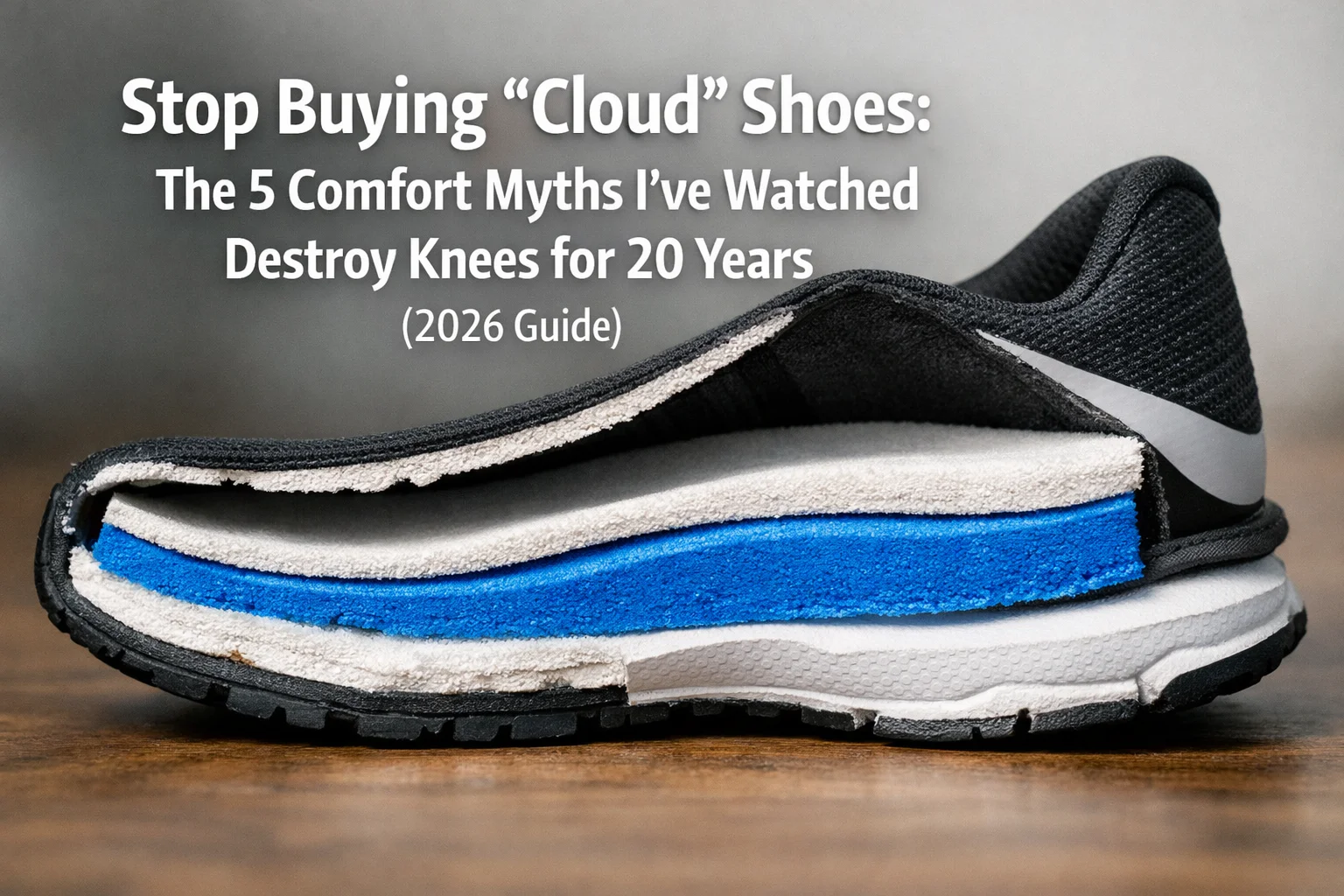
2. The “Marshmallow-Soft” Running Shoe
Many customers come to my fitting stool wearing ultra-plush, highly cushioned running shoes. They are shocked when I tell them these shoes are actually contributing to their heel pain.
When your foot sinks deeply into super-soft, low-density foam, it loses all lateral stability. Your ankle wobbles, and your arch is allowed to collapse inward (overpronation). This lack of structural support forces your stabilizing tendons and fascia to work twice as hard to keep you balanced, resulting in severe foot pain after standing all day.
                [SOFT PLUSH FOAM VS. STRUCTURAL MIDSOLE]

    [Ultra-Soft Cushioning]                 [Rigid Structural Midsole]
    Foot sinks unevenly                     Foot held in neutral plane
    Ankle wobbles inward (Overpronation)    Firm arch support prevents collapse
    Fascia overstretches & tears            Even pressure distribution
3. The Dead Midsole
Many people wear their favorite walking shoes for years because the outsole rubber still looks fine. However, what looks good on the outside can be dead on the inside.
Inside standard athletic shoes is an EVA (Ethylene Vinyl Acetate) foam midsole full of tiny, pressurized air bubbles. Over $300\text{ to }500\text{ miles}$ of walking, those air bubbles pop, and the foam permanently compresses. Once a midsole is dead, it no longer absorbs vertical shock, and it fails to keep your foot in a neutral plane.
RETAIL-FLOOR BUYER Q&A: ANSWERED BY A FOOTWEAR VETERAN
When people sit on my fitting bench, they don’t want to hear complex medical jargon. They want straightforward, honest answers to the practical problems they face. Here are the five questions I get asked most often on the retail floor:
Q1: “Are super-soft, pillowy shoes good for heel pain?”
The honest answer: Absolutely not. This is the single biggest mistake people make. When you step into a shoe with ultra-soft, unstable foam, your heel sinks deeply into the material. This sinking motion forces your arch to flatten and your Achilles tendon to stretch even further to maintain balance. To heal walking heel pain, you need a firm, structurally stable midsole that holds your foot in a neutral position, rather than a mushy foam bed that forces your stabilizing muscles to work twice as hard.
Q2: “Can I just buy expensive insoles, or do I need to buy new shoes?”
The honest answer: An insole is only as good as the shoe it sits in. If you put a high-quality, custom-molded orthotic into a flimsy, worn-out shoe with a soft heel counter, the shoe will simply tilt under your weight, rendering the insole completely useless. You must think of your footwear as a collaborative system: the shoe provides the rigid structural foundation, while the insole provides the direct, personalized arch contact.
Q3: “What is the biggest regret people have after buying shoes online to treat heel pain?”
The honest answer: They buy based on aesthetic reviews rather than structural metrics. Many people read reviews saying, “These are the most comfortable shoes ever!” and buy them, ignoring the shoe’s heel-to-toe drop and midfoot rigidity. If you have tight calves and walking heel pain, buying a zero-drop, flexible knit shoe online will almost certainly aggravate your symptoms, no matter how many five-star reviews it has.
Q4: “How do I know if my shoes are actually worn out, even if the bottoms look fine?”
The honest answer: Look for crease lines in the midsole foam. Take your shoe and look at the side of the white or grey foam midsole. If you see deep, horizontal wrinkles and compression lines, the foam has lost its cellular memory and is completely “packed out.” Another great test is to place the shoe on a flat table and look at it from behind; if the heel counter tilts inward or outward, the shoe’s structural integrity is gone, and it needs to be replaced.
Q5: “Do I really need to wear shoes inside my house if I have hardwood floors?”
The honest answer: Yes, until your heel pain is completely gone. Walking barefoot on hard, flat surfaces is the absolute enemy of recovery. If you hate wearing outdoor shoes inside, buy a dedicated pair of highly structured recovery sandals or indoor clogs with built-in arch support that never touch the outdoor dirt. Keep them next to your bed and wear them for every single indoor step.
PRO TIPS FROM A FOOTWEAR EXPERT: THE 4 INTEGRITY TESTS
Before you take a new pair of shoes to the cash register or keep them from an online delivery, perform these four simple, hands-on tests that we use on the retail floor to check a shoe’s structural integrity:
    [The 4-Step Shoe Build Integrity Test]

  1. The Torsional Twist   ───> Twist shoe like a towel. Midfoot must remain rigid.
  2. The Heel Pinch        ───> Squeeze heel cup. Must resist collapsing inward.
  3. The Flex-Point Fold   ───> Push toe upward. Must bend only at the forefoot.
  4. The Insole Extraction  ───> Pull out footbed. Look for structural lasting boards.
Test 1: The Torsional Rigidity Twist
Hold the shoe in both hands—one hand on the heel, the other on the toe. Now, try to twist the shoe as if you were wringing out a wet towel.
- The Verdict: A supportive walking shoe should resist this twisting motion in the middle. The heel and the forefoot can move slightly, but the midfoot (where your arch sits) must remain completely rigid. If the shoe twists easily into a spiral, it will not protect your arch from collapsing under load when you walk.
Test 2: The Heel Counter Pinch Test
Squeeze the very back of the shoe (the heel counter) between your thumb and forefinger. Try to collapse it inward toward the footbed.
- The Verdict: The heel counter should be stiff and structured, usually reinforced with an internal plastic cup (a thermoplastic heel counter). If you can easily crush the heel counter flat with your thumb, the shoe will not keep your heel locked in place, leading to heel slippage, ankle instability, and increased strain on your Achilles tendon.
Test 3: The Flex Point Fold Test
Place the shoe on a flat table. Press down on the toe of the shoe, forcing it to bend upward, or bend the toe of the shoe back with your hand.
- The Verdict: The shoe must bend only at the ball of the foot pain guide (where your toes naturally bend during the toe-off phase). If the shoe folds in half right in the middle of the arch, it is a biomechanical disaster that will cause severe arch pain and plantar fasciitis.
Test 4: The Insole Extraction Check
Reach inside the shoe and pull out the removable insole. Look at what lies beneath it.
- The Verdict: Is there a solid, flat lasting board stitched neatly to the upper (known as Strobel construction), or is it just a thin piece of mesh glued over hollowed-out plastic channels? A premium walking shoe will have a clean, solid, stitched Strobel construction that provides a flat, stable platform for your foot to rest on.
HEEL PAIN CAUSE & SOLUTION MATRIX
To help you quickly identify your symptoms and find the correct structural shoe requirements, refer to this practical retail comparison matrix:
| Condition | Primary Walking Symptom | Exact Pain Location | Ideal Heel-to-Toe Drop | Essential Shoe Features | Recommended At-Home Action |
|---|---|---|---|---|---|
| Plantar Fasciitis | Sharp, tearing pain at toe-off | Medial tubercle of calcaneus (bottom-inside heel) | Moderate to High ($8\text{mm}$ to $12\text{mm}$) | Rigid midfoot shank, structured arch support, deep heel cup | Stretch toes backward, roll arch over frozen water bottle |
| Achilles Tendonitis | Tight, wooden pull during heel lift | Back of heel, above the bone line | High ($10\text{mm}$ to $12\text{mm}$) | Elevated heel ramp, soft heel collar, supportive heel counter | Perform gentle calf stretches against a wall, avoid zero-drop shoes |
| Fat Pad Atrophy | Deep, bruised, bone-to-floor ache | Center of bottom of the heel | Medium ($6\text{mm}$ to $8\text{mm}$) | Maximum cushioning, built-in heel cradle, thick rubber outsole | Avoid hard-soled shoes, use gel heel cups to consolidate fat pad |
| Calcaneal Fracture | Severe, constant throbbing pain | Both sides of the heel bone | Medium ($6\text{mm}$ to $8\text{mm}$) | High shock absorption, lightweight, cushioned rocker sole | Complete rest, avoid high-impact activities, see a podiatrist |
| Baxter’s Nerve | Burning, tingling, electrical pull | Inside ankle, radiating to bottom heel | Low to Medium ($4\text{mm}$ to $8\text{mm}$) | Motion control, wide anatomical toe box, firm medial posting | Avoid tight straps, perform nerve-gliding exercises |
| Retrocalcaneal Bursitis | Hot, red, swollen friction spot | Very back of heel, on the bone bump | Medium-High ($8\text{mm}$ to $10\text{mm}$) | Soft heel collar, seamless interior, flared heel design | Apply ice, avoid rigid shoe backs, use heel lifts |
| PTTD (Arch Collapse) | Deep, tired ache along inner ankle | Inside ankle, curving under arch | Medium ($6\text{mm}$ to $8\text{mm}$) | Extended medial post, rigid torsion shank, tall ankle collar | Wear custom orthotics, do ankle inversion exercises |
| Calcaneal Spur | Dull, stone-like step-in bruise | Center-forward bottom of heel | High ($10\text{mm}$ to $12\text{mm}$) | Shock-absorbing cavity, structured arch support, firm midsole | Use orthopedic heel cups with center cutouts |
5 CRITICAL MISTAKES TO AVOID WHEN DEALING WITH WALKING HEEL PAIN
Even with the best intentions, it is incredibly easy to make simple shoe-fitting or lifestyle mistakes that prolong your recovery. Here are the five most common errors I see on the retail floor:
1. Sizing Up for Width
When a shoe feels tight across the foot, most people’s natural instinct is to simply buy half a size larger. This is a massive mistake. Sizing up for length means the physical flex point of the shoe will no longer align with the natural flex point of your foot (the ball of your foot). This causes the shoe to bend in the wrong place, putting intense, abnormal leverage on your arch and aggravating your walking heel pain. If your foot is wide, seek out brands that offer dedicated wide widths (EE for men, D for women) rather than sizing up in length.
2. Walking Barefoot on Hard Floors
When you are dealing with walking heel pain, walking barefoot on hardwood, laminate, or tile floors is highly detrimental. Without any structural contour to support your arch, your foot is forced to flatten completely under your full body weight. This sudden stretch causes immediate micro-tearing in the plantar fascia and calf muscles, erasing several days of healing. Always keep a pair of structured, contoured recovery slides or sandals next to your bed and slip into them before taking a single step.
3. Trusting Initial “Unboxing” Comfort
Many people try on a shoe in a store or out of an online box, take three steps on a carpeted floor, and declare it the perfect shoe because it feels “soft and squishy.” As a veteran shoe fitter, I always remind people that step-in softness is an illusion. A shoe that feels like a cloud for three steps can feel like concrete after walking a mile. You must evaluate a shoe based on its structural components—torsional rigidity, heel counter stiffness, and arch contact—not just its initial padding.
4. Over-stretching an Acute Injury
When your heels hurt, your natural instinct is to stretch them as hard as you can. However, if your plantar fascia or Achilles tendon is in an acute, highly inflamed state, aggressive stretching can actually cause more micro-tearing and worsen your condition. Always perform stretches gently and progressively. If a stretch causes sharp, shooting pain, stop immediately and focus on resting and ice-rolling instead.
5. Ignoring Your Biomechanics
We are all unique, and trying to wear a shoe designed for someone else’s foot type is a recipe for chronic pain. If you have flat feet, wearing a shoe with no stability features will cause your arches to collapse. If you have high arches, wearing a stiff, rigid control shoe will prevent your foot from absorbing shock. Before buying your next pair of shoes, take the time to understand your unique foot biomechanics and shop accordingly.
EXTERNAL AUTHORITY REFERENCES
For deep, science-based research on walking heel pain, human biomechanics, and footwear materials, consult these highly respected organizations:
- The American Podiatric Medical Association (APMA): The leading national professional organization representing podiatric physicians in the United States. Look for their “Seal of Acceptance” on footwear brands that actively promote foot health.
- The Journal of Foot and Ankle Research: An open-access, peer-reviewed journal publishing high-quality research on all aspects of the epidemiology, etiology, and clinical management of foot and ankle disorders.
- The International Society of Footwear Biomechanics: A specialized group of researchers focusing on the physical interaction between the human foot and modern shoe materials, providing cutting-edge data on midsole compression and joint loading.
FAQ: 10 HIGHLY SEARCHED QUESTIONS ANSWERED BY A FOOTWEAR VETERAN
Q1: Is walking heel pain always plantar fasciitis?
No. While plantar fasciitis is the most common cause, walking heel pain can also be driven by Achilles tendonitis (back-of-heel pain), fat pad atrophy (bruised center-heel), calcaneal stress fractures (bone-deep ache), or nerve entrapment like Baxter’s nerve syndrome.
Q2: Why does my heel pain seem to get better after I walk for a few minutes?
As you walk, your body heat increases, local circulation improves, and the tight, contracted collagen fibers gradually stretch out and lubricate, transforming a sharp morning stab into a dull, manageable ache.
Q3: Can tight calf muscles actually cause my heels to hurt when I walk?
Yes, absolutely. Your calf muscles connect directly to your heel bone via the Achilles tendon, which is physically linked to your plantar fascia. When your calves are tight, they pull upward on your heel, putting constant, high-tension traction on the bottom of your foot.
Q4: Does walking heel pain go away on its own over time?
Rarely. If you do not address the underlying biomechanical issues—such as wearing unsupportive shoes or walking barefoot on hard floors—the micro-tears will continue to accumulate, turning an acute walking ache into a chronic, highly debilitating injury.
Q5: How long does it typically take to recover from walking heel pain?
If you consistently wear supportive footwear, perform morning stretches, and avoid barefoot walking, typical recovery can range from three to six months. However, severe, untreated cases can persist for a year or more.
Q6: Can wearing high heels cause me to experience walking heel pain?
Yes, definitely. High heels force your calf muscles and Achilles tendon into a highly shortened state. If you wear them frequently during the day, your tissues will become chronically tight, leading to severe pulling and tearing when you step flat on the floor the next day.
Q7: Are custom orthotics better than store-bought insoles for walking heel pain?
Custom orthotics are highly beneficial for severe, unique structural alignment issues. However, for most people, a premium, high-quality, over-the-counter insole that offers rigid arch support and a deep heel cup can provide highly effective relief at a fraction of the cost.
Q8: What features should I look for in a shoe to manage walking heel pain?
You should look for a shoe that passes the “Torsional Twist Test” (rigid midfoot), has a stiff heel counter to lock your heel in place, features structured arch support, and has a moderate heel-to-toe drop ($8\text{mm}$ to $12\text{mm}$) to relieve tendon tension.
Q9: Why does my heel pain return after I sit at my desk for an hour?
This is known as post-static dyskinesia. When you sit and rest, your plantar fascia and Achilles tendon begin to cool down and shorten again. The moment you stand up, you subject those cold, contracted tissues to a sudden stretch, mimicking your first steps of the morning.
Q10: Can sleeping with a night splint actually cure my walking heel pain?
Yes, it is highly effective. A night splint mechanically holds your foot at a perfect $90^\circ$ angle throughout the night, completely preventing your tissues from shortening. This ensures that when you take your first morning steps, your fascia is already stretched and ready for load, eliminating the sharp pain.
CONCLUDING THOUGHTS & THE PATH FORWARD
Walking heel pain is not a life sentence, nor is it something you have to learn to live with as you age. It is simply a physical warning sign from your body that your footwear is failing to support your natural skeletal structure.
       [Your Walking Heel Health Checklist]

  ☐ Stop walking barefoot on hardwood or tile floors first thing in the morning
  ☐ Perform the sheet stretch and arch massage before stepping out of bed
  ☐ Keep a pair of structured recovery slides directly next to your bedside
  ☐ Replace daily shoes that have worn-out, wrinkled midsoles
  ☐ Consider wearing a night splint to keep your tissues elongated while you sleep
If you want to break the cycle of walking in agony, prioritize shoe structure over aesthetic trends. Look for shoes with dense, compression-molded midsoles, rigid midfoot shanks, and supportive heel cups that keep your feet in a neutral plane. Treat your feet with the respect they deserve—after all, they are the foundation of your entire kinetic chain.
READY TO FIND WALKING HEEL PAIN RELIEF?
Don’t let heel pain hold you back from living your life to the fullest. Take the first step toward pain-free movement and recovery:
- Compare Top-Rated Options: Browse our collection of orthopedic-friendly footwear designed with dense midsoles and structured support.
- Check the Latest Prices Online: Find excellent, money-saving deals on expert-recommended comfort footwear.
- Explore Expert-Recommended Picks: See our curated list of the best shoes and slides specifically designed for immediate heel pain relief.