
Why Do My Heels Hurt in the Morning? 6 Real Causes and Proven Solutions
- 🏆 Best Overall: Brooks Men’s Adrenaline GTS 25 – APMA-certified, GuideRails support, DNA LOFT v3 cushioning. The gold standard for plantar fasciitis walkers.
- 💰 Best Value: Women’s Arch Support Slip-On Work Sneaker – Under $37, memory foam insole, 45,000+ reviews. Budget hero for heel pain.
- 🎯 Best for Wide Feet: FitVille Women’s Rebound Core (Wide) – Patented PropelCore sole, wide toe box, built for flat feet & heel spurs.
INTRODUCTION
It is the same story every single day. The alarm goes off at 6:00 AM. You swing your legs over the edge of the bed, stretch your arms, and let your feet meet the floor. But the moment your heel makes contact with the hardwood, a sharp, white-hot stab of pain shoots straight up your leg. You gasp, catch your breath, and spend the next ten steps limping like a pirate, desperately holding onto the nightstand, dresser, and hallway wall just to make it to the bathroom.
Over twenty years of fitting shoes on the retail floor, I have had hundreds of customers describe this exact morning ritual to me. They sit on my fitting bench, look at me with exhausted eyes, and ask: “Why on earth do my heels hurt so badly when I first get out of bed, only to feel a little bit better after I walk around for ten minutes?”
Many of these people have spent hundreds of dollars on highly recommended, heavily cushioned sneakers, yet they are still crippled by those agonizing first steps. They are constantly searching online, asking why do my feet hurt so intensely when they are supposedly resting all night.
The hard truth is that sleep—the very state designed to heal our bodies—is actually the prime setup for morning heel pain. While you are sleeping, your body is actively trying to heal the micro-tears in your lower limbs. But because of how your feet rest overnight, that healing occurs in a shortened position. The moment you stand up, you violently rip those healing fibers apart.
This guide is going to walk you through the biomechanics of sleep and standing, analyze the six real medical and footwear-related causes behind your morning heel pain, and provide you with actionable, retail-tested strategies and stretches to finally wake up without pain.
THE BIOMECHANICS OF SLEEP VS. STANDING: THE FIRST-STEP SHOCK
To understand why your heels throb when you first wake up, we must examine the physical state of your feet during eight hours of sleep.
The Nocturnal Plantarflexion Problem
When you lie down in bed, your feet do not rest at a perfect $90^\circ$ angle relative to your shins. Instead, gravity, the heavy weight of your blankets, and the natural relaxation of your calf muscles cause your feet to point slightly downward. This position is known biomechanically as plantarflexion.
In a state of plantarflexion:
- The plantar fascia (the thick, fibrous band of connective tissue running along the sole of your foot) is placed in its shortest possible state.
- The Achilles tendon (the massive cord linking your calf muscles to your heel bone) is also heavily contracted and shortened.
- The calf muscles (gastrocnemius and soleus) remain in a relaxed, shortened position.
       [NOCTURNAL PLANTARFLEXION - Shortened State]

            Leg (Shins/Calves)
                 \
                  \
                   \______  <-- Foot points down (blanket pressure)
                   (      )     Plantar fascia & Achilles contract overnight
                    \____/      Healing occurs in this shortened position
While you are sleeping, your body is in high-repair mode. It floods these overnight-contracted tissues with fibroblasts and collagen to patch up any microscopic tears you accumulated from walking, running, or standing the day before. Your body essentially tries to “knit” your fascia and tendons back together.
The Morning Load Vector
When you swing your legs out of bed and place your feet flat on the ground, your ankle joint is forced from a plantarflexed state (pointing down) into a dorsiflexed state (at or beyond a $90^\circ$ angle).
Suddenly, your full body weight—let’s say $150\text{ to }200\text{ pounds}$—is placed directly onto those cold, stiff, newly knitted tissues.
       [MORNING LOAD VECTOR - Sudden Dorsiflexion]

            Leg (90-Degree Angle)
              |
              |  <-- Full body weight drops vertically
             _|_
            |___| <-- Foot forced flat on floor
                      Tissues are violently stretched, ripping the overnight healing
The result? The delicate, newly formed collagen fibers that your body spent all night building are instantly and violently torn apart. This is why you experience that sharp, agonizing, tearing sensation on your very first step.
Once you walk around for a few minutes, the tissues warm up, blood flow increases, the fibers gradually stretch out, and the pain transitions from a sharp stab to a dull, manageable ache. However, the damage is already done, and the cycle repeats itself the very next morning.
THE 6 REAL CAUSES OF MORNING HEEL PAIN
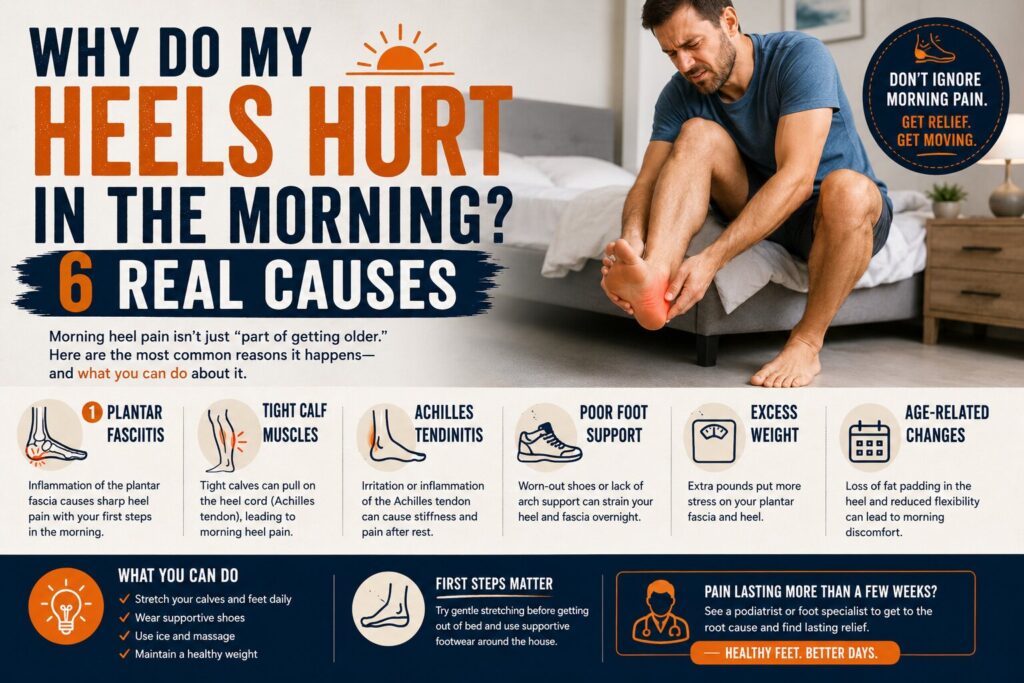
While plantar fasciitis is the most famous reason people search for why their feet hurt when first wake up, it is far from the only cause. As an experienced shoe fitter, I have learned that misdiagnosing your pain can lead to buying the completely wrong footwear, which only worsens your condition.
Let’s break down the six real causes of morning heel pain so you can pinpoint your exact issue.
                         [The 6 Causes Location Map]

                                Achilles Tendonitis (Back of Heel)
                                       |
                                       V
                         _______     _____
                        /       \___/     \ <-- Calcaneal Spur (Traction point)
                       /                   \
                      /                     \ <-- Fat Pad Atrophy (Center of Heel)
                     /                       \
     Front of Foot  (_________________________)
                                 |
                                 V
                      Plantar Fasciitis (Arch attachment point)
CAUSE 1: PLANTAR FASCIITIS (THE MASTER OF MORNING AGONY)
Plantar fasciitis is the undisputed king of morning heel pain. It affects nearly $10\%$ of the US population at some point in their lives, making it the most frequent complaint I handle.
The Pathology
The plantar fascia is a thick, multi-segmented ligament designed to act as a shock absorber and support the longitudinal arch of your foot. When you walk, it stretches and recoils, distributing your weight evenly across your kinetic chain.
When you overwork this tissue—through excessive standing, sudden increases in activity, or wearing completely flat shoes—it develops micro-tears near its insertion point on the medial tubercle of the calcaneus (the inside corner of your heel bone). This leads to chronic inflammation, thickening of the fascia, and severe morning stiffness.
The Morning Pain Signature
- Location: The pain is highly localized on the bottom-inside corner of the heel.
- Sensation: A sharp, needle-like stab or a sensation of walking directly on a bruised bone.
- Behavior: Peak agony on the first $5\text{ to }10\text{ steps}$, gradually dissipating into a dull ache as you move, only to return after sitting at your desk for an hour (a phenomenon known as “post-static dyskinesia”).
If you suspect this is your issue, you need to address the inflammation immediately. Reading our comprehensive guide on how to relieve plantar fasciitis pain fast will give you immediate, actionable home remedies to calm the tissue down before your next morning steps.
CAUSE 2: ACHILLES TENDONITIS AND TENDINOSIS (THE BACK-OF-HEEL PULL)
If your morning pain is located at the very back of your heel rather than the bottom, you are likely dealing with Achilles tendonitis.
The Pathology
The Achilles tendon is the thickest and strongest tendon in the human body, responsible for transmitting the massive forces generated by your calf muscles down to your foot to push you forward. If you frequently wear running shoes with high heel drops or work in construction boots, and then suddenly switch to flat, zero-drop gym shoes or walk barefoot, you place immense mechanical strain on this tendon.
Overuse leads to micro-tears, either at the midpoint of the tendon (midbody Achilles tendonitis) or directly where it inserts into the back of your heel bone (insertional Achilles tendonitis).
The Morning Pain Signature
- Location: The back of the heel, ranging from the heel bone upward about $2\text{ to }4\text{ inches}$.
- Sensation: A thick, stiff, wooden sensation. It feels like your heel is anchored to your calf by a tight, unyielding metal cable.
- Behavior: Severe morning stiffness. Bending your foot upward to put on socks feels nearly impossible without intense pulling and aching at the back of the ankle.
CAUSE 3: CALCANEAL BONE SPURS (THE CHRONIC TRACTION RESULTS)
There is a massive amount of confusion surrounding bone spurs. Many people come to my store believing that a sharp bone is physically growing downward and poking into their flesh with every step.
The Pathology
In reality, a calcaneal spur is a shelf-like bone growth that develops horizontally along the path of the plantar fascia. It is not a cause of pain in itself, but rather a structural reaction to long-term, chronic tension.
When your plantar fascia is constantly pulled tight like a bowstring, it exerts continuous traction on your heel bone. In response to this constant pulling, your body deposits calcium along the line of stress to reinforce the bone.
This complex biological relationship is why many podiatrists emphasize the diagnostic difference between heel spurs vs plantar fasciitis. While the spur itself is often painless (it runs parallel to the ground and does not point downward), the inflamed, swollen soft tissue surrounding the spur is what causes the excruciating morning pain.
The Morning Pain Signature
- Location: The center-forward portion of the bottom of the heel.
- Sensation: A deep, bruised, dull ache that feels like stepping on a marble.
- Behavior: The pain remains fairly consistent throughout the day, aggravated by hard surfaces and thin-soled shoes that offer no shock-absorption cavity for the spur area.
CAUSE 4: HEEL FAT PAD ATROPHY (THE WEAR-DOWN OF NATURAL CUSHIONING)
Many of my older customers, or runners who spend years logging miles on hard asphalt, develop morning heel pain that has nothing to do with tendon or ligament inflammation. Instead, it is a structural loss of their built-in shock absorbers.
The Pathology
Directly beneath your calcaneus sits a specialized cushion of adipose (fat) tissue, mapped out in tiny, pressurized chambers called fat septae. This fat pad is your body’s primary shock absorber, designed to cushion the $110\%$ of your body weight that lands on your heel with every single stride.
As we age, or due to repetitive high impacts, these fat chambers lose their elasticity, flatten out, or shift out of position. This condition is known as fat pad atrophy. Once this cushion is depleted, your heel bone is essentially resting directly on the hard skin and floor.
The Morning Pain Signature
- Location: The absolute center of the heel pad.
- Sensation: A deep, bruised, hollow ache. It feels like you are walking barefoot directly on concrete.
- Behavior: Unlike plantar fasciitis, which usually improves after walking for ten minutes, fat pad atrophy pain actually worsens the more you walk. It is highly sensitive to static standing on hard surfaces.
CAUSE 5: TARSAL TUNNEL SYNDROME (THE PINCHED NOCTURNAL NERVE)
Sometimes, morning heel pain isn’t an orthopedic issue at all—it’s a neurological one.
The Pathology
Running down the inside of your ankle, just behind that bony bump, is a narrow pathway called the tarsal tunnel. Through this tunnel pass several tendons and, most importantly, the posterior tibial nerve.
If your feet naturally roll inward excessively (overpronation) when you sleep, or if you wear tight, restrictive footwear during the day, this tunnel can become compressed. While you sleep, fluid retention and certain foot positions can increase pressure inside this narrow canal, pinching the posterior tibial nerve.
The Morning Pain Signature
- Location: Broadly radiating across the bottom of the heel, sometimes shooting into the arch or the toes.
- Sensation: Burning, tingling, “pins and needles,” or a strange numbness. It does not feel like a typical muscular or ligamentous pull.
- Behavior: The pain often wakes you up in the middle of the night or is highly active the moment you take your first morning steps. Massaging the heel does not relieve it; instead, it may cause a shooting, electrical sensation.
CAUSE 6: SYSTEMIC INFLAMMATORY CONDITIONS (THE AUTOIMMUNE TRAP)
If you have tried every shoe, insole, and stretch imaginable, and your morning heel pain simply refuses to budge, your issue might be systemic.
The Pathology
Several autoimmune and systemic inflammatory conditions have a strong affinity for entheses—the specific points where tendons and ligaments attach to bone. This inflammation is known as enthesitis.
Conditions like Ankylosing Spondylitis (AS), Psoriatic Arthritis, Rheumatoid Arthritis, and Gout can cause intense, chronic inflammation at both the plantar fascia insertion point and the Achilles tendon insertion point.
The Morning Pain Signature
- Location: Often bilateral (affecting both heels equally) and accompanied by general joint stiffness in the hands, knees, or lower back.
- Sensation: A hot, throbbing, swollen, and highly sensitive pain.
- Behavior: Extreme morning stiffness that can last for hours, rather than minutes. It improves significantly with hot showers and systemic anti-inflammatory medication, but is largely unresponsive to typical orthopedic shoe modifications.
THE FOOTWEAR CULPRITS: HOW YOUR SHOES AGGRAVATE MORNING HEEL PAIN
As a shoe fitter, I spend half my day analyzing what people wear and the other half explaining why those choices are keeping them in pain. Your footwear choices throughout the day directly dictate how your heels feel the next morning.
Here are the three most common footwear culprits that set you up for morning agony:
1. The “Barefoot First Step” Disaster
The absolute worst thing you can do for morning heel pain is to step out of bed and walk barefoot on hardwood, laminate, or tile floors.
When your feet are cold and tight, stepping directly onto an unyielding, flat surface forces your foot to flatten completely. Without any structural contour to support your arch, your plantar fascia is instantly stretched to its maximum physical limit under high velocity.
This sudden, high-load stretch causes immediate micro-tearing. Even if you wear supportive shoes during the day, that single barefoot journey from your bed to the coffee pot can erase a whole week of tissue healing.
                  [Barefoot on Hardwood vs. Supportive Slide]

    [Barefoot on Flat Floor]              [Wearing Orthopedic Slide]
    No support = Arch collapses           Contoured arch = Holds foot neutral
    Fascia violently overstretches        Fascia rests in a supported state
    Agonizing morning tears               Gentle, pain-free transition
2. The Danger of “Marshmallow-Soft” House Slippers
Many customers tell me, “I don’t walk barefoot! I wear memory foam slippers the moment I get up.”
Unfortunately, standard memory foam slippers are a massive trap. Memory foam is highly heat-sensitive; within two minutes of your warm foot resting on it, the foam loses all structural resistance and “bottoms out” under your weight.
Furthermore, these slippers lack a structured heel counter and lateral stability. As a result, your heel is allowed to tilt and slide off the side of the slipper platform, causing your ankle to wobble and placing intense, uneven traction on your plantar fascia and Achilles tendon.
3. Worn-Out Athletic Midsoles
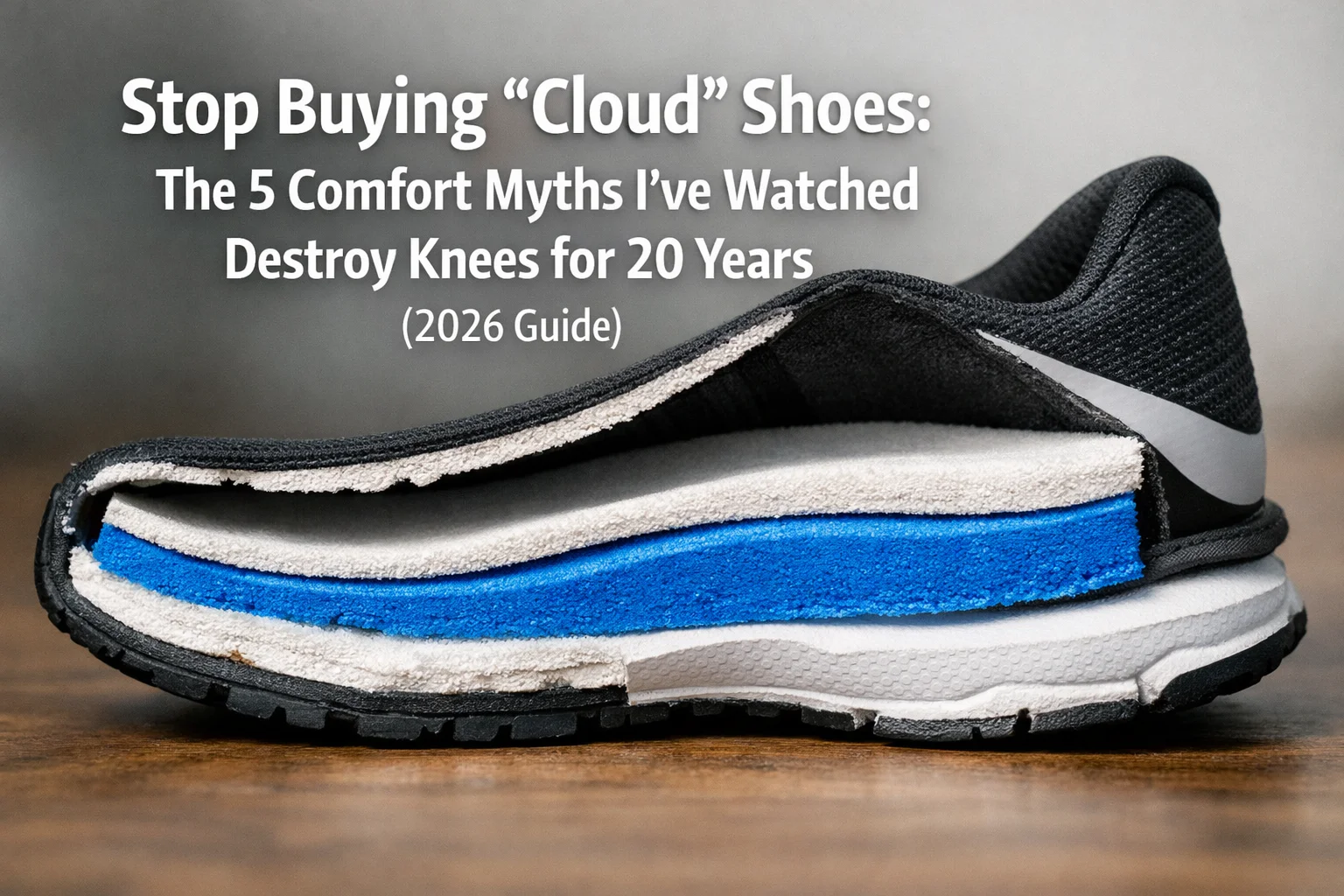
Many people wear their favorite sneakers for years because they “feel broken in.” However, what feels soft is often a dead midsole.
Inside standard athletic shoes is an EVA (Ethylene Vinyl Acetate) foam midsole full of tiny, pressurized air bubbles. Over $300\text{ to }500\text{ miles}$ of walking or standing, those air bubbles pop, and the foam permanently compresses.
Once a midsole is dead, it no longer absorbs vertical shock, and it fails to keep your foot in a neutral plane. If you wear these worn-out shoes during the day, your feet accumulate massive amounts of micro-trauma, leaving you to pay the physical price with severe morning heel pain the next day.
ACTIVE MORNING RECOVERY: THE 3-STEP “BEFORE-YOU-STEP” ROUTINE
To break the daily cycle of morning heel pain, you must change how your feet transition from sleep to standing. I always instruct my customers to perform this simple, three-step active recovery routine before their feet ever touch the bedroom floor:
    [The Morning Pre-Step Recovery Routine]

  Step 1: The Sheet Stretch  ───> Pull toes toward shins with bedsheet for 30 seconds.
  Step 2: The Arch Massage   ───> Cross foot over knee and massage sole for 1 minute.
  Step 3: The Slide Slip-On  ───> Slip feet directly into structured recovery slides.
Step 1: The Sheet Stretch (Nocturnal Reversal)
Before you sit up, grab your bedsheet, a towel, or a yoga strap.
- Loop the fabric around the ball of your foot, keeping your leg straight.
- Gently pull the fabric toward your chest, drawing your toes up toward your shins.
- Hold this position for $30\text{ seconds}$ without bouncing. Repeat three times per foot.
- The Biomechanics: This movement gently and progressively transitions your Achilles tendon and plantar fascia from their shortened, nighttime state into a fully extended state, preventing that sudden, high-load tearing on your first step.
Step 2: The Cross-Leg Arch Massage
Sit up on the edge of your bed and cross your painful foot over your opposite knee.
- Using one hand, pull your toes back toward your shin to tension the plantar fascia.
- Using the thumb of your other hand, apply firm, circular pressure along the sole of your foot, starting from the ball of your foot and moving slowly down toward your heel.
- Perform this massage for $1\text{ to }2\text{ minutes}$ until you feel the tissue begin to soften and warm up.
- The Biomechanics: This manual mobilization breaks up minor overnight adhesions, increases local circulation, and floods the stiff collagen fibers with warm, oxygenated blood to prepare them for load-bearing.
Step 3: The Slide Slip-On
Do not place your bare feet on the floor. Instead, have a pair of highly structured, contoured recovery slides or sandals resting directly next to your bed.
- Slip your feet straight into the slides before standing up.
- Slowly stand, letting the built-in, deep heel cup and robust arch support take the initial load.
- The Biomechanics: The contoured footbed mechanically holds your foot in a neutral alignment, preventing your arch from collapsing and ensuring that your plantar fascia is not subjected to a violent, unsupported stretch.
To keep your tissues gently elongated throughout the night, using a specialized night splint for plantar fasciitis is a highly effective long-term solution. It physically prevents your foot from pointing downward while you sleep, completely eliminating the morning shortening cycle.
RETAIL-FLOOR BUYER Q&A: ANSWERED BY A FOOTWEAR VETERAN
When people sit on my fitting bench, they don’t want to hear complex medical jargon. They want straightforward, honest answers to the practical problems they face. Here are the five questions I get asked most often on the retail floor:
Q1: “Are super-soft, pillowy shoes good for morning heel pain?”
The honest answer: Absolutely not. This is the single biggest mistake people make. When you step into a shoe with ultra-soft, unstable foam, your heel sinks deeply into the material. This sinking motion forces your arch to flatten and your Achilles tendon to stretch even further to maintain balance.
To heal morning heel pain, you need a firm, structurally stable midsole that holds your foot in a neutral position, rather than a mushy foam bed that forces your stabilizing muscles to work twice as hard.
Q2: “Can I just buy expensive insoles, or do I need to buy new shoes?”
The honest answer: An insole is only as good as the shoe it sits in. If you put a high-quality, custom-molded orthotic into a flimsy, worn-out shoe with a soft heel counter, the shoe will simply tilt under your weight, rendering the insole completely useless. You must think of your footwear as a collaborative system: the shoe provides the rigid structural foundation, while the insole provides the direct, personalized arch contact.
Q3: “What is the biggest regret people have after buying shoes online to treat heel pain?”
The honest answer: They buy based on aesthetic reviews rather than structural metrics. Many people read reviews saying, “These are the most comfortable shoes ever!” and buy them, ignoring the shoe’s heel-to-toe drop and midfoot rigidity.
If you have tight calves and morning heel pain, buying a zero-drop, flexible knit shoe online will almost certainly aggravate your symptoms, no matter how many five-star reviews it has.
Q4: “How do I know if my shoes are actually worn out, even if the bottoms look fine?”
The honest answer: Look for crease lines in the midsole foam. Take your shoe and look at the side of the white or grey foam midsole.
If you see deep, horizontal wrinkles and compression lines, the foam has lost its cellular memory and is completely “packed out.” Another great test is to place the shoe on a flat table and look at it from behind; if the heel counter tilts inward or outward, the shoe’s structural integrity is gone, and it needs to be replaced.
Q5: “Do I really need to wear shoes inside my house if I have hardwood floors?”
The honest answer: Yes, until your heel pain is completely gone. Walking barefoot on hard, flat surfaces is the absolute enemy of recovery.
If you hate wearing outdoor shoes inside, buy a dedicated pair of highly structured recovery sandals or indoor clogs with built-in arch support that never touch the outdoor dirt. Keep them next to your bed and wear them for every single indoor step.
MORNING HEEL PAIN CAUSE & SOLUTION MATRIX
To help you quickly identify your symptoms and find the correct structural shoe requirements, refer to this practical retail comparison matrix:
| Condition | Primary Morning Symptom | Exact Pain Location | Ideal Heel-to-Toe Drop | Essential Shoe Features | Recommended At-Home Action |
|---|---|---|---|---|---|
| Plantar Fasciitis | Sharp, needle-like stab on first steps | Medial tubercle of calcaneus (bottom-inside heel) | Moderate to High ($8\text{mm}$ to $12\text{mm}$) | Rigid midfoot shank, structured arch support, deep heel cup | Stretch toes backward, roll arch over frozen water bottle |
| Achilles Tendonitis | Thick, tight, stiff wooden sensation | Back of heel, above the bone line | High ($10\text{mm}$ to $12\text{mm}$) | Elevated heel ramp, soft heel collar, supportive heel counter | Perform gentle calf stretches against a wall, avoid zero-drop shoes |
| Fat Pad Atrophy | Deep, bruised, hollow ache | Center of bottom of the heel | Medium ($6\text{mm}$ to $8\text{mm}$) | Maximum cushioning, built-in heel cradle, thick rubber outsole | Avoid hard-soled shoes, use gel heel cups to consolidate fat pad |
| Tarsal Tunnel Syndrome | Burning, tingling, electrical numbness | Medial ankle, radiating across bottom of foot | Low to Medium ($4\text{mm}$ to $8\text{mm}$) | Motion control, wide anatomical toe box, firm medial posting | Avoid tight straps, perform nerve-gliding exercises |
| Enthesitis (Systemic) | Throbbing, hot, swollen stiffness | Both heels equally, lasting hours | Medium ($6\text{mm}$ to $8\text{mm}$) | Flexible forefoot, high shock absorption, seamless interior | Take systemic anti-inflammatories, take warm morning showers |
5 CRITICAL MISTAKES TO AVOID WHEN DEALING WITH MORNING HEEL PAIN
Even with the best intentions, it is incredibly easy to make simple shoe-fitting or lifestyle mistakes that prolong your recovery. Here are the five most common errors I see on the retail floor:
1. Choosing Style Over Foot Biomechanics
We all want to look good, but squeezing your feet into narrow, flat, unsupportive fashion sneakers or rigid dress shoes because they match an aesthetic is a recipe for chronic pain.
If your heels hurt in the morning, you must prioritize structural support. Look for premium brands that integrate medical-grade orthotic contours into clean, modern designs, rather than sacrificing your long-term mobility for a fast-fashion look.
2. Buying the Wrong Shoe Width to Fix Tightness
When a shoe feels tight across the foot, most people’s natural instinct is to simply buy half a size larger. This is a massive mistake.
Sizing up for length means the physical flex point of the shoe will no longer align with the natural flex point of your foot (the ball of your foot). This causes the shoe to bend in the wrong place, putting intense, abnormal leverage on your arch and aggravating your morning heel pain. If your foot is wide, seek out brands that offer dedicated wide widths (EE for men, D for women) rather than sizing up in length.
3. Ignoring the Heel-to-Toe Drop
The “heel-to-toe drop” is the difference in height between the heel of your shoe and the forefoot. If you transition abruptly from a traditional dress shoe or work boot with a high drop to a zero-drop minimalist running shoe, you will put sudden, immense mechanical strain on your calf muscles and Achilles tendon.
Understanding this dynamic is crucial, which is why choosing the correct heel drop for plantar fasciitis is a critical first step in shoe selection. If your calf muscles are tight, you need a slightly elevated heel drop to mechanically relax the tendon while you work on structural healing.
4. Over-stretching an Acute Injury
When your heels hurt, your natural instinct is to stretch them as hard as you can. However, if your plantar fascia or Achilles tendon is in an acute, highly inflamed state, aggressive stretching can actually cause more micro-tearing and worsen your condition.
Always perform stretches gently and progressively. If a stretch causes sharp, shooting pain, stop immediately and focus on resting and ice-rolling instead.
5. Trusting Initial “Unboxing” Comfort
Many people try on a shoe in a store or out of an online box, take three steps on a carpeted floor, and declare it the perfect shoe because it feels “soft and squishy.”
As a veteran shoe fitter, I always remind people that step-in softness is an illusion. A shoe that feels like a cloud for three steps can feel like concrete after standing for an eight-hour shift.
You must evaluate a shoe based on its structural components—torsional rigidity, heel counter stiffness, and arch contact—not just its initial padding.
REFERENCES
For deep, science-based research on morning heel pain, human biomechanics, and footwear materials, consult these highly respected organizations:
- The American Podiatric Medical Association (APMA): The leading national professional organization representing podiatric physicians in the United States. Look for their “Seal of Acceptance” on footwear brands that actively promote foot health.
- The Journal of Foot and Ankle Research: An open-access, peer-reviewed journal publishing high-quality research on all aspects of the epidemiology, etiology, and clinical management of foot and ankle disorders.
- The International Society of Footwear Biomechanics: A specialized group of researchers focusing on the physical interaction between the human foot and modern shoe materials, providing cutting-edge data on midsole compression and joint loading.
FAQ: 10 HIGHLY SEARCHED QUESTIONS ANSWERED BY A FOOTWEAR VETERAN
Q1: Is morning heel pain always plantar fasciitis?
No. While plantar fasciitis is the most common cause, morning heel pain can also be driven by Achilles tendonitis (back-of-heel pain), fat pad atrophy (bruised center-heel), or nerve entrapment like tarsal tunnel syndrome.
Q2: Why does my heel pain seem to get better after I walk for a few minutes?
As you walk, your body heat increases, local circulation improves, and the tight, contracted overnight collagen fibers gradually stretch out and lubricate, transforming a sharp morning stab into a dull, manageable ache.
Q3: Can tight calf muscles actually cause my heels to hurt in the morning?
Yes, absolutely. Your calf muscles connect directly to your heel bone via the Achilles tendon, which is physically linked to your plantar fascia. When your calves are tight, they pull upward on your heel, putting constant, high-tension traction on the bottom of your foot and causing severe tight calves foot pain.
Q4: Does morning heel pain go away on its own over time?
Rarely. If you do not address the underlying biomechanical issues—such as wearing unsupportive shoes or walking barefoot on hard floors—the micro-tears will continue to accumulate, turning an acute morning ache into a chronic, highly debilitating injury.
Q5: How long does it typically take to recover from morning heel pain?
If you consistently wear supportive footwear, perform morning stretches, and avoid barefoot walking, typical plantar fasciitis recovery time can range from three to six months. However, severe, untreated cases can persist for a year or more.
Q6: Can wearing high heels cause me to experience morning heel pain?
Yes, definitely. High heels force your calf muscles and Achilles tendon into a highly shortened state. If you wear them frequently during the day, your tissues will become chronically tight, leading to severe pulling and morning tearing when you step flat on the floor the next day.
Q7: Are custom orthotics better than store-bought insoles for morning heel pain?
Custom orthotics are highly beneficial for severe, unique structural alignment issues. However, for most people, a premium, high-quality, over-the-counter insole that offers rigid arch support and a deep heel cup can provide highly effective relief at a fraction of the cost.
Q8: What features should I look for in a shoe to manage morning heel pain?
You should look for a shoe that passes the “Torsional Twist Test” (rigid midfoot), has a stiff heel counter to lock your heel in place, features structured arch support, and has a moderate heel-to-toe drop ($8\text{mm}$ to $12\text{mm}$) to relieve tendon tension.
Q9: Why does my morning heel pain return after I sit at my desk for an hour?
This is known as post-static dyskinesia. When you sit and rest, your plantar fascia and Achilles tendon begin to cool down and shorten again. The moment you stand up, you subject those cold, contracted tissues to a sudden stretch, mimicking your first steps of the morning.
Q10: Can sleeping with a night splint actually cure my morning heel pain?
Yes, it is highly effective. A night splint mechanically holds your foot at a perfect $90^\circ$ angle throughout the night, completely preventing your tissues from shortening. This ensures that when you take your first morning steps, your fascia is already stretched and ready for load, eliminating the sharp pain.
CONCLUDING THOUGHTS & THE PATH FORWARD
Morning heel pain is not a life sentence, nor is it something you have to learn to live with as you age. It is simply a physical warning sign from your body that your footwear is failing to support your natural skeletal structure and that your morning transition is too abrupt.
       [Your Morning Heel Health Checklist]

  ☐ Stop walking barefoot on hardwood or tile floors first thing in the morning
  ☐ Perform the sheet stretch and arch massage before stepping out of bed
  ☐ Keep a pair of structured recovery slides directly next to your bedside
  ☐ Replace daily shoes that have worn-out, wrinkled midsoles
  ☐ Consider wearing a night splint to keep your tissues elongated while you sleep
If you want to break the cycle of waking up in agony, prioritize shoe structure over aesthetic trends. Look for shoes with dense, compression-molded midsoles, rigid midfoot shanks, and supportive heel cups that keep your feet in a neutral plane. Treat your feet with the respect they deserve—after all, they are the foundation of your entire kinetic chain.
READY TO FIND MORNING HEEL PAIN RELIEF?
Don’t let morning heel pain ruin the start of your day. Take your first step toward pain-free movement and recovery:
- Compare Top-Rated Options: Browse our collection of orthopedic-friendly footwear designed with dense midsoles and structured support.
- Check the Latest Prices Online: Find excellent, money-saving deals on expert-recommended comfort footwear.
- Explore Expert-Recommended Picks: See our curated list of the best shoes and slides specifically designed for immediate morning heel pain relief.