

Can Women Wear Men’s Sneakers? A unisex size shoes chart Conversion Guide (2026)
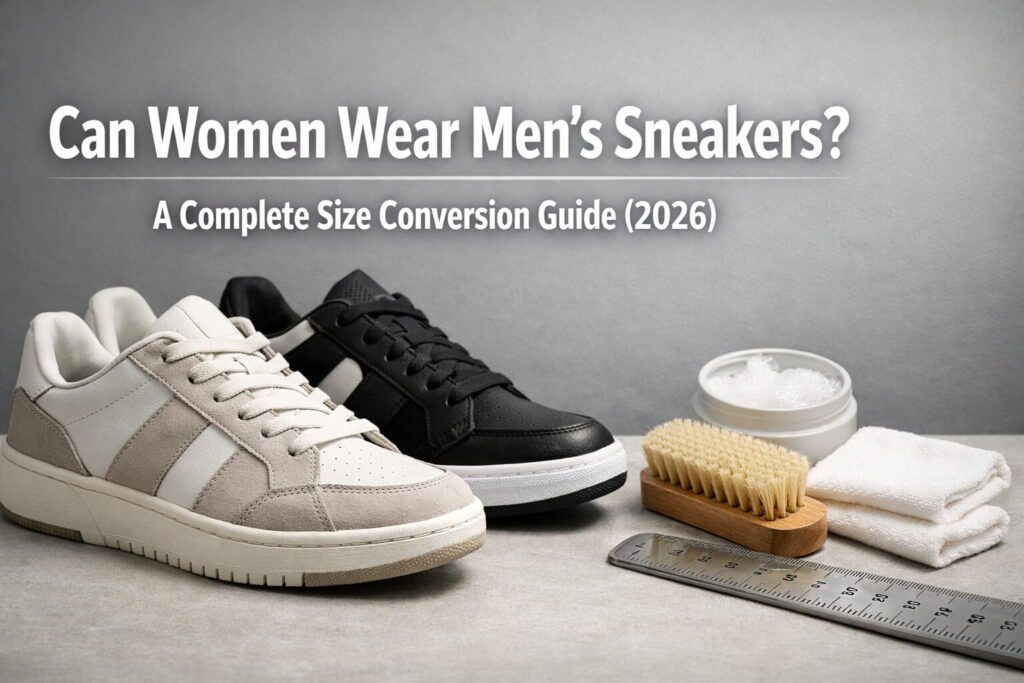
TL;DR: The Quick Answer unisex size shoes chart
Yes, women can absolutely wear men’s sneakers, and many do to access exclusive colorways or a wider fit. The general rule of thumb for US sizing is a 1.5 size difference. For example, if you wear a US Women’s 8.5, you would fit a US Men’s 7. However, men’s shoes are built on a wider last (Standard D width) compared to women’s (Standard B width). If you have narrow feet, you may experience heel slippage; if you have wide feet, men’s sneakers might actually be the better choice for comfort.
Introduction: The Sneaker Envy Is Real
We have all been there. You are scrolling through a release calendar or walking past a store window, and you spot the perfect pair of sneakers. The silhouette is sharp, the colorway is limited-edition fire, and the materials look premium. You rush to check the size, only to realize it’s a “Men’s Exclusive” release.
For decades, the footwear industry drew a hard line between genders. But in the last few years, that line has blurred significantly. Whether it is for the “chunky dad shoe” aesthetic, better durability, or simply because brands often release their best designs in men’s sizing first, the crossover market is exploding globally.
As someone who has spent over 20 years running a physical shoe store and handling thousands of fittings, I can tell you that a foot is a foot. The anatomy varies, but the rules of comfort are universal. I have helped countless women find better comfort in men’s aisles, simply because the industry standard “women’s fit” was too narrow for them.
In this guide, we aren’t just saying “yes, do it.” We are going to break down exactly how to do it right, focusing on the unisex size shoes chart, width differences between Nike and Adidas, and the expert checks you need to make before hitting the “Buy” button.
Why This Topic Matters (unisex size shoes chart)
Why does this specific guide matter in 2026? Because online returns are a nightmare, and most of them happen due to sizing misconceptions.
In my two decades of experience, I’ve noticed a recurring pattern. A customer sees a “Unisex” label and assumes the fit is identical to their specific gendered shoe. It rarely is. “Unisex” is often just a marketing term for “Men’s sizing graded down to fit smaller feet.”
If you are shopping from London, New York, or Sydney, relying purely on a generic size tag is a gamble. Brands use different “lasts” (the mold used to shape the shoe). A Nike Air Force 1 in a men’s size 7 fits differently than a women’s size 8.5, even if the length is theoretically the same.
Understanding the mechanics of a unisex shoe size guide saves you money on return shipping and saves your feet from blisters caused by heel slippage or crushed toes.
The Golden Rule: Understanding the Conversion
If you take only one thing away from this article, let it be the math. While European (EU) and UK sizing systems are often more straightforward (a UK 6 is often a UK 6 regardless of gender, though widths vary), the US sizing system requires a specific formula.
The Magic Number: 1.5
For most major athletic brands, including Nike, Jordan Brand, New Balance, and Asics, the size difference is 1.5.
- The Formula: (Your US Women’s Size) – 1.5 = (US Men’s Size)
- Example: Women’s 9 – 1.5 = Men’s 7.5
The Adidas Exception
Adidas can be tricky. Historically, their conversion has sometimes been closer to 1 size difference rather than 1.5. If you are looking at a unisex footwear size chart for Adidas styles like the Samba or Gazelle, always check the specific Centimeter (CM) or Japanese (JP) measurement. The CM measurement is the only truth in the footwear world because it measures the actual length of the insole.
Expert Tip: If you are buying a hype sneaker like a Dunk or a Yeezy, look at the box label. Many modern boxes now list both the Men’s and Women’s sizes clearly. If they don’t, stick to the 1.5 rule for length.
The Hidden Variable: Width (The “B” vs. “D” Factor)
This is the secret sauce that most online blogs miss. Length is only half the battle; volume is the war.
In the shoe industry, width fits are categorized by letters:
- Women’s Standard Width: B
- Men’s Standard Width: D
When a woman buys a men’s sneaker, she is effectively jumping up a width size from B to D.
Who is this GOOD for?
If you have wide feet, bunions, or high arches that usually feel constricted in standard women’s shoes, switching to men’s sneakers is an amazing “hack.” You get more room in the toe box without having to hunt for specialty “Wide” sizes which often look orthopedic.
Who is this BAD for?
If you have narrow feet or very slender ankles, wearing a men’s D-width sneaker will likely cause heel slippage. This is when your heel lifts out of the shoe with every step. Over a long day of walking or travel, this friction creates blisters.
Brand-Specific Guide: Nike vs. Adidas
Nike & Jordan Brand
Nike is the king of the crossover. Because the Air Jordan 1 and Dunk silhouettes are so popular, Nike has mastered the unisex appeal.
- The Fit: Nike generally runs true to the 1.5 conversion rule.
- The Feel: Nike silhouettes tend to be slightly narrower in the midfoot than other brands, which makes the transition from women’s to men’s easier. A men’s Nike shoe often feels snug enough for a woman’s foot.
- Best Models for Crossover: Air Force 1, Dunk Low, Air Max 1, Jordan 1 Retro High.
Adidas
Adidas offers a slightly different experience, largely due to their construction materials (Primeknit, softer leathers).
- The Fit: Often runs slightly long or wide.
- The Feel: Models like the Stan Smith or Superstar have a very wide toe box. If you are a woman wearing a men’s Adidas, you might need to size down an extra half size (so, a 2-size difference) or wear thicker socks.
- Best Models for Crossover: Ultraboost (very forgiving fit), Samba, Gazelle, Yeezy (runs small, size up).
Pro-Tip Section: Retailer-Only Insights
Over 20 years, I’ve developed a few “quality checks” that I use in-store. Since you are likely buying online, you can do these at home once the box arrives.
1. The Insole Check
Don’t just put the shoe on. Take the insole (footbed) out of the men’s sneaker. Place your foot on top of it while standing.
- Does your heel fit within the cup of the insole?
- Is there about a thumb’s width of space at the toe?
- Does your foot spill over the sides? If the insole matches your foot, the shoe will fit.
2. The Lacing Lock
If you buy a men’s sneaker and find the heel is slipping slightly, do not return it immediately. Utilize the extra eyelet at the very top of the shoe (the one everyone ignores). Look up “Runner’s Loop Lacing.” This technique locks the heel back against the counter of the shoe, tightening the collar without crushing your toes. It is a game-changer for women wearing men’s shoes.
3. Material Shortcuts
Be aware that sometimes, “Grade School” (GS) sizes overlap with Men’s and Women’s sizes. A GS size 7 is technically the same length as a Men’s 7. However, GS shoes are often built with cheaper materials (synthetic leather vs. full-grain) to keep costs down for kids. Always try to buy the Men’s version, not the Youth/GS version, if you want adult durability.
Comparison: Men’s vs. Women’s Sneaker Build unisex size shoes chart
| Feature | Men’s Sneakers (Standard) | Women’s Sneakers (Standard) | The Impact |
|---|---|---|---|
| Standard Width | D (Medium/Wide) | B (Medium/Narrow) | Men’s offer more toe room; Women’s hug the heel better. |
| Arch Support | Placed for longer foot | Placed for higher arch | Men’s arches may feel slightly “flat” to some women. |
| Heel Cup | Wider | Narrower | Main source of slippage for women in men’s shoes. |
| Midsole Density | Firmer (for heavier mass) | Softer (for lighter mass) | Men’s shoes may feel stiffer initially and take longer to break in. |
| Colorways | Earth tones, Primary colors | Pastels, Metallics, Pinks | Purely aesthetic, but men’s generally have higher resale value. |
Common Mistakes to Avoid
- Ignoring the Socks: When trying to make a men’s shoe work, the socks you wear matter. If you are trying on a chunky New Balance 9060 in a men’s size, wear the thick athletic socks you plan to use. Testing with thin liners will give you a false sense of fit.
- Assuming Unisex = Women’s Fit: A unisex size shoes chart generally relies on men’s dimensions. If a brand sells a shoe as “Unisex,” assume it is a D-width shoe. If you have narrow feet, you will likely need to size down.
- Trusting the “EU” Size Blindly: This is a classic rookie mistake. A Nike EU 40 is not the same physical length as an Adidas EU 40 or a Birkenstock EU 40. Always convert using US sizes or CM (Japan) sizes for accuracy.
People Also Ask (PAA)
Can a woman wear men’s shoes if she has wide feet? Absolutely. Men’s shoes are constructed on a “D” width last, which is wider than the standard women’s “B” last, making them an excellent, comfortable option for women with wide feet or bunions.
Is a men’s size 7 the same as a women’s size 7? No. In US sizing, men’s shoes are larger. A men’s size 7 is roughly equivalent to a women’s size 8.5. In the UK system, the numerical size is often the same, but the men’s version will be wider.
Do men’s shoes last longer than women’s? Generally, yes. Men’s sneakers often utilize denser foam densities in the midsole to support heavier body mass, which can result in a shoe that maintains its cushion structure longer for a lighter wearer.
What is the size difference between men’s and women’s Nike shoes? There is a 1.5 size difference. If you wear a women’s US 9, you should look for a men’s US 7.5.
Are unisex shoes just men’s shoes? In 90% of cases, yes. Unisex footwear is typically built on a men’s lasting mold (D width) and graded down to smaller sizes to accommodate women, rather than being built on a specific unisex mold.
Conclusion & Where to Buy
Navigating the world of unisex footwear size charts opens up a massive inventory of styles that you previously ignored. Whether you are chasing a limited Jordan release or just want a wider, more comfortable walking shoe, the men’s aisle is open for business.
Remember the formula: Size Down 1.5. Check the width. Trust the CM measurement.
As we move through 2026, the lines between gendered footwear will only continue to fade. Comfort and style are the only metrics that truly matter.
Ready to find your fit? Don’t guess with your hard-earned money. We recommend checking the official size guides and customer reviews on major platforms before buying.
- [Check today’s top-rated Unisex Sneakers on Amazon]
- [Browse Nike’s Official Size Conversion Charts]
- [Compare prices on StockX for Men’s Exclusives]
(Disclaimer: As an affiliate, we may earn a commission from qualifying purchases. This helps support our independent reviews.)
FAQs
1. How do I use a unisex size shoes chart guide correctly?
To use a unisex shoe size guide, identify your standard US Women’s size and subtract 1.5 to find your US Men’s equivalent. For example, a Women’s 10 converts to a Men’s 8.5. Always cross-reference with the Centimeter (CM) length for exact precision.
2. Are men’s sneakers cheaper than women’s?
Retail prices are usually identical for the same model (e.g., an Air Max 90). However, men’s shoes often have higher resale value on the secondary market. Conversely, buying “Grade School” (GS) sizes can be significantly cheaper, though quality may be lower.
3. Do Converse run unisex?
Yes, Converse Chuck Taylors are the definition of unisex. However, they run large. The box usually lists both men’s and women’s sizes (e.g., Mens 5 / Womens 7). The standard conversion holds true, but most people size down a half size in Converse generally.
4. Will men’s shoes hurt my arches?
They shouldn’t, but the arch placement might feel different. Men’s feet are generally longer and flatter. If you have very high arches, you might find men’s insoles lack the necessary contour. This is easily fixed by swapping in a quality aftermarket insole.
5. Can I wear men’s running shoes?
Yes, but be careful. Running shoes are biomechanically engineered. Men’s running shoes are designed for a heavier impact load and have a wider heel. If you are a petite woman, the foam might be too stiff to compress correctly, leading to joint pain. For casual wear, it’s fine; for marathons, stick to gender-specific shoes.
6. Why are unisex sizes often sold out?
The “golden sizes” (Men’s 7 through 9) are the most competitive sizes in the sneaker world because they fit the average man and the average woman (Women’s 8.5 to 10.5). High demand from both genders leads to faster sell-outs.
7. Does the 1.5 size rule apply to UK sizes?
No. The 1.5 rule is for US sizing only. For UK sizing, a Men’s 6 is often legally the same length as a Women’s 6, though the men’s version will be wider. Always check the specific brand chart for UK conversions.
8. What is the difference between GS (Grade School) and Men’s sizes?
A GS size 7 and a Men’s size 7 are the same length, but the GS version has a narrower heel, lower ankle collar, and often uses lighter, less durable materials. Men’s versions include advanced tech (like Zoom Air units) that might be stripped out of GS versions.
9. Can I return men’s shoes if I am a woman?
Yes. Return policies are based on the condition of the item, not the gender of the buyer. As long as the shoes are unworn and in the original box, online retailers like Nike, Adidas, and Amazon accept returns regardless of who bought them.
10. Are Vans unisex?
Yes, Vans are universally unisex. Their sizing structure is very standard. A generic Vans slip-on in Men’s 8 will be labeled clearly as Women’s 9.5 on the box and tongue tag. They fit true to size for both genders.
Pingback: Indian Shoe Size vs. UK Shoe Size: Complete 2026 Conversion Guide