
How to Clean Insoles of Smelly Shoes and Whiten Shoe Soles: 2026 Guide
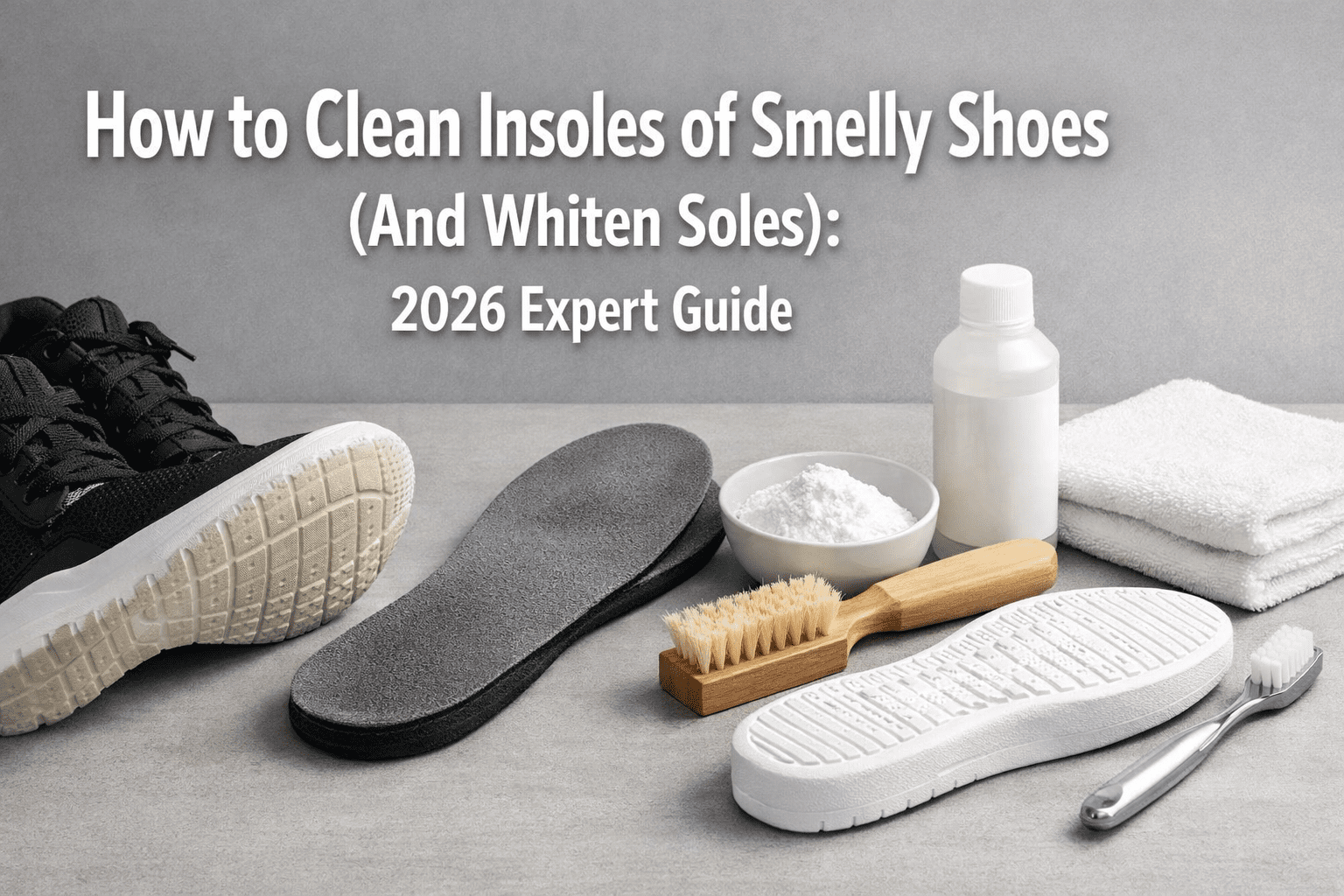
How to clean shoe insoles: Remove the insoles when possible, brush away loose dirt, and clean them according to their material. For many fabric and foam insoles, use mild soap and water, avoid excessive soaking, and allow them to air dry completely before putting them back in your shoes.
Take out removable insoles and remove loose dirt before cleaning.
Use a small amount of mild soap and water for compatible materials.
Clean away sweat and buildup, then use baking soda when suitable.
Air dry the insoles fully before returning them to the shoes.
Smelly shoes are often caused by what happens inside the shoe, not just on the outside. Insoles absorb moisture, sweat, skin oils and dirt over time, so cleaning the insole can make a noticeable difference to both odor and comfort.
The right cleaning method depends on the material. Removable foam and fabric insoles can usually be cleaned with mild soap and water, while leather, suede, memory foam and fixed footbeds need more careful treatment.
This guide explains how to clean shoe insoles, remove odor, clean non-removable insoles, care for Birkenstock-style footbeds, clean memory foam insoles, and whiten yellowing shoe soles without using unnecessarily aggressive methods.
Quick Answer: How Do You Clean Shoe Insoles?
For removable fabric or foam insoles, remove them from the shoe, brush away loose dirt, gently clean with mild soap and water, remove excess moisture with a towel, and let them air dry completely.
For odor, baking soda can be used as a dry deodorizing treatment. Insoles.com recommends placing dry insoles with baking soda in a bag overnight and then removing the powder.
For leather or fixed footbeds, use much less water and follow the manufacturer’s care instructions.
For memory foam, avoid unnecessary soaking. Many manufacturers recommend gentle hand washing and air drying rather than machine washing or heat drying.
Why Do Shoe Insoles Smell?
Shoe insoles spend hours in a warm, enclosed environment while absorbing moisture and oils from your feet.
Insoles.com notes that insoles absorb moisture, oils, dust and dirt, and recommends regular cleaning and airing to help control odor and extend their useful life.
Foot odor can also be influenced by sweating, socks, footwear ventilation and how long the shoes remain damp.
The practical solution is therefore not simply to cover the smell with fragrance. You need to:
Clean the insole → remove excess moisture → dry it completely → allow the shoe to air out.
If persistent foot odor is accompanied by itching, scaling, skin changes or other symptoms, cleaning the footwear alone may not address the underlying problem.
Identify Your Insole Before Cleaning It
The first step is to identify what you are cleaning.
| Insole Type | Recommended Approach | Main Risk |
| Fabric + foam | Mild soap and limited water | Over-saturation |
| EVA foam | Gentle cleaning | Heat damage |
| Memory foam | Gentle hand cleaning | Water retention |
| Gel | Mild soap and water if manufacturer allows | Harsh chemicals |
| Leather | Damp cloth / material-specific cleaner | Excess water |
| Suede footbed | Suede-specific care | Flattening or staining |
| Fixed/glued insole | Spot clean only | Water entering the shoe |
| Orthotic/insole with special materials | Follow manufacturer instructions | Damaging support structure |
There is no universal cleaning method for every insole.
For example, Insoles.com says gel and cloth insoles can generally be cleaned with soap and water, while foam insoles can be cleaned with soapy water or vinegar and water, followed by air drying. It also recommends extra care with leather.
How to Clean Removable Shoe Insoles
This is the easiest situation because you can clean the insole separately from the shoe.
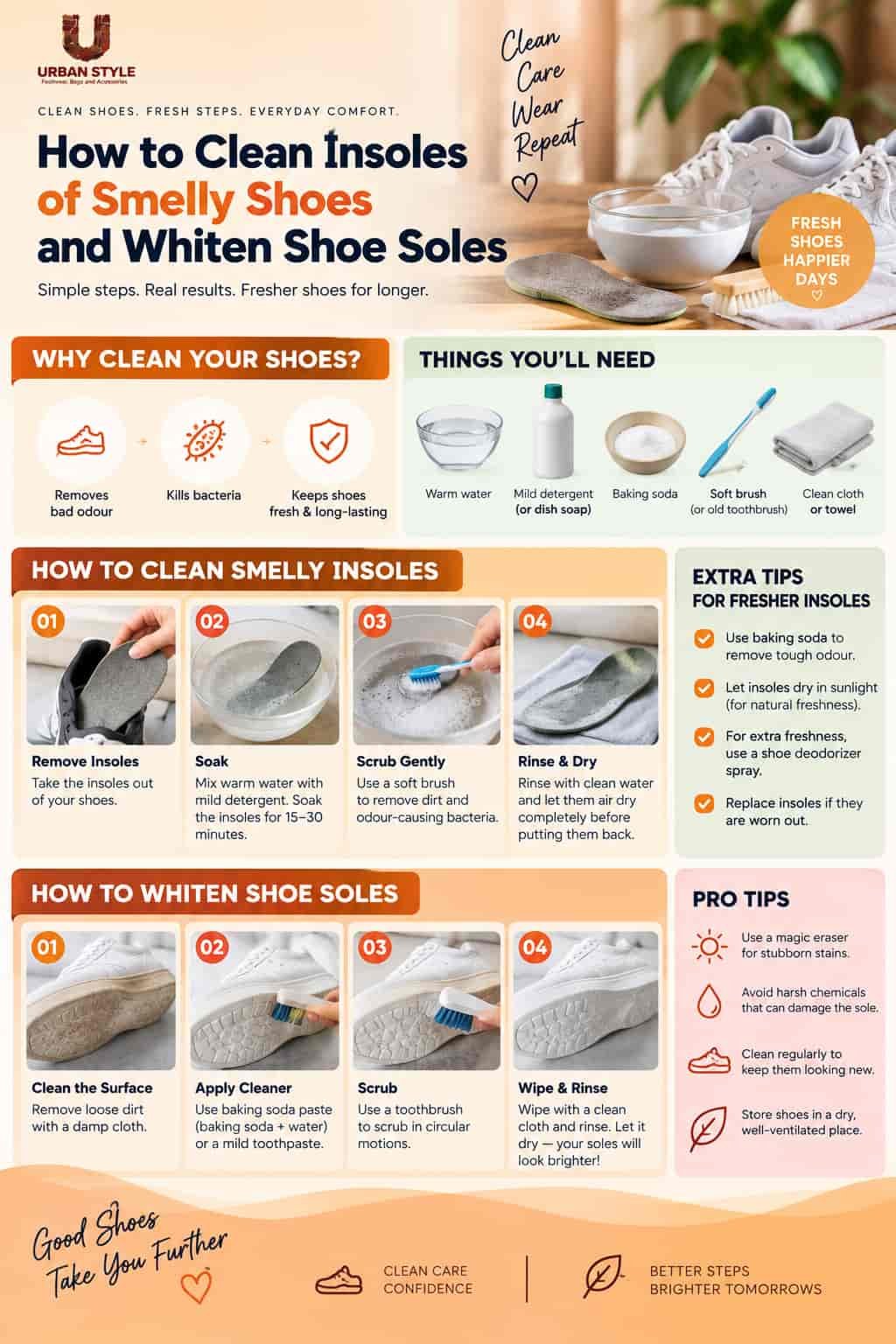
What You Need
- Mild liquid soap or detergent
- Soft-bristle brush
- Clean cloth
- Lukewarm water
- Dry towel
- Well-ventilated drying area
Avoid starting with strong chemicals. A mild cleaner is usually enough for everyday dirt and sweat residue.
Step 1: Remove the Insoles
Take both insoles completely out of the shoes.
If an insole is glued down, do not force it out. Move to the non-removable insole method later in this guide.
For removable inserts, cleaning them separately allows the shoe interior and the insole to dry independently.
Step 2: Brush Away Dry Dirt
Before introducing water, use a soft brush to remove:
- Dust
- Sand
- Hair
- Sock fibers
- Dried dirt
This prevents you from turning loose debris into wet grime during washing.
A soft toothbrush works well for edges and textured areas.
Step 3: Prepare a Mild Cleaning Solution
Mix a small amount of mild detergent with lukewarm water.
You do not need a heavily concentrated solution.
The objective is to remove sweat, oils and surface dirt without saturating the foam.
Step 4: Gently Scrub the Insole
Dip the soft brush into the solution and work across the surface.
Pay particular attention to:
- Heel area
- Forefoot
- Toe area
- Edges
- Visible stains
Use gentle circular movements rather than aggressive scrubbing.
For many washable insoles, this is enough to remove everyday dirt.
Step 5: Remove the Soap
Do not automatically hold a foam insole under running water.
Instead, use a clean damp cloth or sponge to remove excess soap.
This reduces the amount of water that the foam needs to absorb.
Insoles.com similarly recommends cleaning with mild soap and water while avoiding unnecessary saturation, followed by air drying.
Step 6: Remove Excess Water
Place the cleaned insole on a clean towel and gently press.
Do not twist or aggressively wring foam inserts.
The objective is to remove surface moisture without deforming the insole.
Step 7: Air Dry Completely
Place the insoles somewhere dry and well ventilated.
A fan can improve airflow.
Avoid:
- Radiators
- Clothes dryers
- Direct high heat
- Heat vents
- Hot car interiors
Superfeet’s current care instructions for several removable insole models specifically recommend hand washing, removing excess water with a towel and air drying, while advising against machine washing, machine drying and heat sources.
How to Clean Smelly Shoe Insoles
If the insole looks clean but still smells, focus on odor control and drying.
Baking Soda Method
Baking soda can be used as a dry deodorizing treatment.
How to do it:
- Make sure the insole is completely dry.
- Place the insoles in a clean bag or container.
- Add baking soda.
- Leave them overnight.
- Remove the insoles.
- Shake or brush away the remaining powder.
Insoles.com recommends using 1 to 2 teaspoons of baking soda in a large bag with the insoles and leaving them overnight before removing the powder.
Important
Do not rely on baking soda to replace cleaning when the insole is visibly dirty.
Think of it as a deodorizing step, not a complete cleaning system.
The Better Odor-Control Routine
For persistent odor, use this sequence:
1. Clean the insole
Remove sweat, dirt and residue.
2. Dry completely
Moisture left inside the foam can contribute to continued odor.
3. Air the shoes
Remove the insoles when possible and allow both components to dry.
4. Deodorize
Use baking soda or a product specifically designed for footwear.
5. Rotate footwear
If possible, avoid wearing the same pair continuously before it has dried.
Insoles.com recommends airing insoles regularly and alternating pairs of insoles when they are used frequently.
How to Clean Non-Removable Insoles
If the insole is glued into the shoe, do not try to rip it out.
Instead:
- Remove the laces if they obstruct access.
- Brush away loose dirt.
- Prepare a small amount of mild soapy water.
- Dip a cloth into the solution.
- Wring it out thoroughly.
- Wipe the insole surface.
- Use a soft toothbrush for difficult areas.
- Wipe again with a clean damp cloth.
- Press a dry towel against the surface.
- Leave the shoe open until completely dry.
Avoid soaking the entire shoe
This is particularly important for shoes containing:
- Foam
- Leather
- Suede
- Glued components
- Orthotic structures
- Multiple layered materials
If the manufacturer’s instructions allow a more thorough cleaning method, follow those instructions instead.
How to Clean Memory Foam Insoles
Memory foam needs extra care because it can hold water inside its structure.
For removable memory-foam inserts:
- Use mild soap.
- Use limited water.
- Avoid aggressive scrubbing.
- Press out excess moisture with a towel.
- Allow plenty of time to air dry.
- Avoid high heat.
Superfeet’s current memory-foam insole care guidance recommends hand washing, using a soft toothbrush when needed, removing excess water with a towel and air drying, while advising against heat sources and machine washing/drying for that product.
However, not every memory-foam insole has the same construction.
Always check the manufacturer’s care label first.
How to Clean Birkenstock Insoles and Footbeds
Birkenstock-style footbeds require more material-specific care than a removable fabric sneaker insole.
The key issue is that different models and footbeds can contain materials such as:
- Suede
- Leather
- Cork
- Latex
- Foam
Do not automatically use a strong vinegar solution, sandpaper or household cleaner on every Birkenstock.
For a specific Birkenstock footbed, follow the manufacturer’s instructions for that model.
For example, BIRKENSTOCK’s cleaning instructions for its Blue Footbed recommend removing the footbed, brushing away coarse dirt, cleaning with mild lukewarm soapy water, rinsing, and then air drying at room temperature. The instructions specifically say not to place the footbed on a radiator or another heat source and not to clean it in a washing machine or dryer.
Important correction to the old vinegar method
A blanket 50/50 vinegar-and-water recommendation should not be presented as the universal solution for Birkenstock footbeds.
Material, model and manufacturer’s instructions matter.
Should You Sand a Birkenstock Footbed?
Use caution with this advice.
Light brushing may be appropriate for some suede footbeds, but aggressive sanding can permanently remove material.
Instead of treating sandpaper as a universal “secret trick”:
Brush first → use the manufacturer’s recommended cleaner → allow the footbed to dry → reassess.
Only use a specialized footbed-cleaning method if the manufacturer or product-care instructions support it.
How to Whiten Yellowing Shoe Soles
Yellowing is a different problem from cleaning a dirty insole.
White rubber and other shoe materials can change appearance through staining, oxidation and aging.
Before using a chemical treatment, identify whether you are cleaning:
- Rubber
- EVA
- TPU
- Painted material
- Foam
- A coated outsole
Do not assume that every yellow sole can be safely treated with hydrogen peroxide.
Safer First Step: Clean the Sole
Start with:
- Remove loose dirt.
- Use mild soap and water.
- Scrub the outsole with a soft or medium brush.
- Wipe away residue.
- Allow the sole to dry.
- Check whether the remaining yellowing is actually oxidation.
If dirt is the cause, you may not need a chemical treatment at all.
Hydrogen Peroxide for White Shoe Soles
Hydrogen peroxide can be used in some shoe-cleaning methods, but concentration and material compatibility matter.
Nike’s current shoe-cleaning guidance describes using 3% hydrogen peroxide with baking soda for cleaning and brightening certain white shoes. It also warns against using bleach on delicate materials such as leather or suede.
Nike also describes 3% hydrogen peroxide as one option for disinfecting and stain removal on certain shoes.
If you use a peroxide-based treatment:
- Test a small area first.
- Keep it away from delicate colored materials.
- Avoid mixing chemicals casually.
- Follow the product instructions.
- Rinse or wipe away residue appropriately.
- Allow the shoe to dry completely.
Do not assume sunlight is required
The old article recommended a specific 1 to 3 hour direct-sunlight treatment.
That is too universal.
UV exposure and heat can affect shoe materials differently, so follow the instructions for the specific cleaning product rather than treating a fixed sunlight period as a standard.
Cleaning Agent Comparison
| Cleaning Method | Best Use | Main Caution |
| Mild soap + water | General insole cleaning | Avoid soaking |
| Baking soda | Odor control | Use on dry materials |
| White vinegar solution | Some compatible materials | Test first |
| 3% hydrogen peroxide | Certain white materials | Can affect color/materials |
| Rubbing alcohol | Some targeted sanitizing uses | Test material first |
| Bleach | Limited material-specific whitening | Can damage materials |
| Manufacturer cleaner | Specific footwear materials | Follow product instructions |
The safest choice is usually the least aggressive method that solves the problem.
What Not to Use on Every Shoe
Some cleaning advice is too broad for footwear.
Avoid treating these as universal solutions:
- Undiluted bleach
- Strong solvents
- Acetone
- High heat
- Boiling water
- Aggressive sanding
- Long soaking
- Random chemical mixtures
Different footwear materials can react very differently.
How to Dry Insoles Faster
The safest way to speed drying is airflow, not high heat.
Better options:
- Use a fan.
- Keep the shoe open.
- Remove the laces.
- Remove the insole if possible.
- Place the shoe in a dry, ventilated room.
- Rotate the position periodically.
Avoid putting foam or leather insoles directly against a radiator or heater.
Manufacturer instructions from Superfeet and BIRKENSTOCK both emphasize air drying and avoiding direct heat sources.
How Often Should You Clean Shoe Insoles?
There is no single schedule that works for everyone.
Cleaning frequency depends on:
- How often you wear the shoes
- How much you sweat
- Exercise intensity
- Climate
- Sock material
- Insole material
- Whether the shoe dries completely between uses
Instead of automatically washing every pair every two weeks, inspect the insole.
Clean sooner when:
- It smells noticeably bad.
- It feels damp after drying.
- Visible dirt has accumulated.
- The surface becomes sticky or grimy.
- You have worn the shoes during heavy exercise.
For frequently worn insoles, regular airing and cleaning are recommended by insole manufacturers.
How to Prevent Smelly Insoles
Cleaning is only half of the solution.
1. Let Shoes Dry Between Uses
Remove the insoles when possible and allow both components to air.
2. Rotate Shoes
If you have two suitable pairs, alternating them gives each pair more time to dry.
3. Use Appropriate Socks
Socks can influence how much moisture reaches the shoe.
The American Podiatric Medical Association notes that appropriate athletic socks can help with moisture management and that socks made from suitable natural/synthetic blends can help wick moisture.
4. Keep the Inside of the Shoe Clean
Cleaning only the removable insole may not solve odor if the lining and interior are also dirty.
5. Replace Worn Insoles
Cleaning cannot restore foam that has permanently compressed or deteriorated.
When Should You Replace Your Insoles?
Sometimes cleaning is no longer the right solution.
Consider replacing an insole when it has:
- Permanent compression
- Cracks
- Peeling top fabric
- Deformation
- Persistent odor despite proper cleaning
- Damaged support components
- Visible deterioration
Replacement timing depends heavily on the material, activity level and construction.
For example, Superfeet currently lists a useful-life guideline of up to 12 months or 500 miles, whichever comes first, for several of its insole models, while other products can have different care and replacement recommendations.
Do not apply one replacement schedule to every insole brand.
Should You Clean or Replace Your Insoles?
Clean It or Replace It?
Use these three checks before buying new insoles.
If the foam and top fabric are intact, cleaning may be worthwhile.
Clean, dry and deodorize before deciding the insole is finished.
Cleaning cannot restore permanently damaged foam or support structures.
Common Mistakes When Cleaning Shoe Insoles
1. Soaking Foam for Too Long
Foam can retain water and take much longer to dry.
Better: Use limited water and remove excess moisture with a towel.
2. Using High Heat
Heat can affect foam, adhesives and leather.
Better: Air dry.
3. Using Strong Chemicals Without Testing
A cleaner that works on white rubber may damage colored fabric or leather.
Better: Test first.
4. Cleaning Only the Insole
The shoe lining can also retain moisture and odor.
Better: Clean the insole and air out the shoe interior.
5. Ignoring the Socks
Socks influence the amount of sweat and moisture reaching the shoe.
Better: Use socks appropriate for your activity and keep them clean.
6. Continuing to Use a Damaged Insole
A worn insole cannot always be restored by cleaning.
Better: Replace it when the structure or cushioning has deteriorated.
Frequently Asked Questions
Can you wash shoe insoles?
Many removable insoles can be cleaned with soap and water, but not every insole should be washed the same way. Check the manufacturer’s care instructions first.
How do you clean insoles of shoes?
Remove the insole if possible, brush away loose dirt, gently clean it with mild soap and water, remove excess moisture with a towel and air dry completely.
How do you clean smelly shoe insoles?
Clean them first, dry them completely and then use a dry deodorizing method such as baking soda if appropriate for the material. Insoles.com recommends baking soda as an odor-neutralizing option.
Can you wash memory foam insoles?
Some can be hand washed, but follow the manufacturer’s instructions. Superfeet recommends hand washing certain memory-foam products and air drying them rather than machine washing or drying.
How do you clean non-removable insoles?
Use a lightly damp cloth with mild soap and gently wipe the surface. Avoid soaking the entire shoe.
Can you put shoe insoles in the washing machine?
Only if the manufacturer specifically says the insole is machine washable. Some products are designed for machine washing, while others specifically say not to machine wash.
How do you dry shoe insoles quickly?
Use airflow. A fan and a well-ventilated room are safer than direct heat. Manufacturer guidance from Superfeet and BIRKENSTOCK recommends air drying and avoiding heat sources.
Does baking soda remove shoe odor?
It can help neutralize odor, particularly as a dry treatment. It should not replace cleaning when the insole is dirty.
Can you use vinegar to clean shoe insoles?
Some compatible insoles can be cleaned with a diluted vinegar solution, but it should not be treated as a universal method. Test first and follow the manufacturer’s material-specific instructions. Insoles.com lists a 50/50 white-distilled-vinegar-and-water method for compatible insoles.
How do you clean Birkenstock footbeds?
Follow the instructions for your specific model. BIRKENSTOCK’s Blue Footbed instructions recommend mild lukewarm soapy water, brushing, rinsing and air drying at room temperature while avoiding radiators, washing machines and dryers.
How do you whiten yellow shoe soles?
Start with mild soap and water. For compatible white shoes, Nike describes a 3% hydrogen peroxide and baking soda treatment for brightening certain white materials. Test first because peroxide can affect colors and materials.
Is hydrogen peroxide safe for shoe insoles?
It depends on the material. Hydrogen peroxide can affect colors and finishes, so it should not be treated as a universal insole cleaner.
When should you replace shoe insoles?
Replace them when they are permanently compressed, damaged, deformed or no longer provide the intended support. Replacement intervals vary by product. Some Superfeet models specify up to 12 months or 500 miles, whichever comes first.
Final Verdict
The best way to clean smelly shoe insoles is not to use the strongest chemical you can find.
Start with the simplest suitable method:
Remove → Brush → Mild Clean → Remove Excess Water → Air Dry → Deodorize → Inspect
For removable foam and fabric inserts, mild soap and controlled water are a good starting point.
For memory foam, leather, suede and specialized footbeds, follow material-specific instructions.
For yellowing soles, clean the surface first and only move to a peroxide-based treatment when the material is compatible.
And if an insole is permanently compressed, cracked or damaged, cleaning will not restore its original structure. Replacement is the more practical solution.
Recommended Footwear Care Resources
For more shoe-care guidance, see our:
- Shoe Care Guide
- How We Test Shoes: Our Footwear Testing Methodology
- How to Wash Skechers in a Washing Machine
- How to Repair a Separated Shoe Sole
Need New Insoles?
If your current insoles are permanently compressed or damaged, consider replacing them rather than repeatedly cleaning them.
Affiliate disclosure: Some links on this page are affiliate links. We may earn a commission if you purchase through them, at no additional cost to you.