

Derby Shoes vs Oxford Shoes 2026: The Ultimate Formal Shoe Types Guide
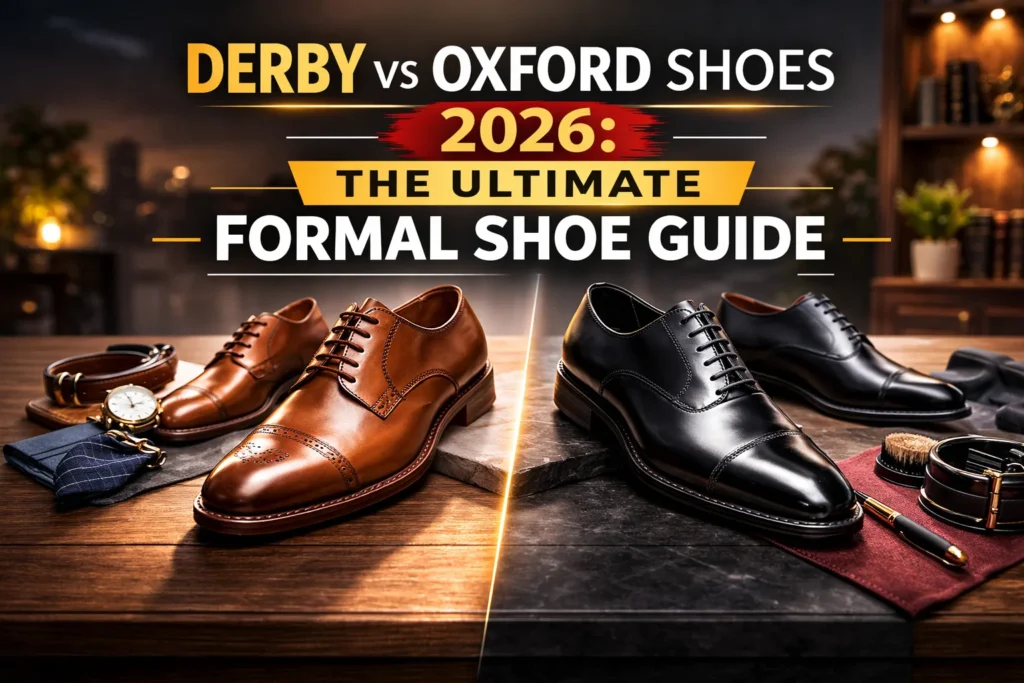
Have you ever stared blankly at a wall of leather shoes—or endlessly scrolled through an online store—wondering why two pairs of shoes that look nearly identical have completely different names?
You are definitely not alone. The global footwear market is flooded with terminology that leaves most guys guessing. Just last week, I was scrolling through a menswear thread on Reddit where a guy was having an absolute meltdown. He had bought a beautiful, expensive pair of sleek lace-ups for his office job, only to realize by 2 PM that the top of his foot was being mercilessly crushed.
The top comment was blunt but accurate: “You bought an Oxford when your foot needed a Derby, mate.”
It’s a classic mistake. Understanding the difference between Oxford and Derby shoes isn’t just about fashion snobbery; it is the literal difference between walking in absolute comfort and hobbling to your car after a long day at work. Whether you are buying for a wedding, daily office wear, or a business trip, knowing your formal shoe types is the ultimate buyer’s superpower.
TL;DR: The Quick Answer
The main difference between Oxford and Derby shoes is the lacing system. Oxfords feature a closed lacing system, where the eyelet tabs are sewn under the shoe’s vamp, creating a sleek, rigid, formal look. Derby shoes have an open lacing system, with tabs sewn on top of the vamp, allowing for a wider, more forgiving fit.
- Derby Shoes vs Oxford Shoes 2026: The Ultimate Formal Shoe Types Guide
- Why Getting This Right Actually Matters
- What Are Oxford Shoes? The King of Formality
- What Are Derby Shoes? The Versatile Workhorse
- The Great Debate: Derby vs Oxford vs Brogue
- Occasion Guide: When to Wear Derby vs Oxford
- Material & Sole Deep-Dive: Comfort vs Durability
- Side-by-Side Comparison: Derby vs Oxford
- Retailer Insight: The "Pinch Test" Pro-Tip
- Common Buying Mistakes to Avoid
- Quick-Fire Footwear Queries
- Behind the Shoebox: Real World Expertise
- Ready to Upgrade Your Footwear?
- Common Style & Sizing FAQs
Why Getting This Right Actually Matters
Buying shoes online has revolutionized how we shop, but it has also introduced a massive problem: you can’t feel the fit through a screen.
Over my years running a physical shoe shop and fitting thousands of customers from all walks of life, I’ve seen the same pattern repeat globally. People choose shoes based purely on the photo, ignoring the construction. They buy a highly restrictive shoe for a wide foot, or a casual shoe for a black-tie event.
There’s an old meme floating around Facebook of a guy wearing a sharp $1,000 tuxedo paired with chunky, casual brown Derbies. The caption? “When you have a gala at 8 but need to chop wood at 9.” To avoid being that guy—and to avoid wasting your money—we need to break down the anatomy of these two classic shoes.
What Are Oxford Shoes? The King of Formality
If you are looking at the most formal shoe in a man’s wardrobe, you are looking at an Oxford. Originating from Scotland and Ireland (and later popularized by Oxford University students), this shoe is defined by one strict rule: Closed Lacing.
The Anatomy of an Oxford
Look at the area where the shoelaces go through the holes (the eyelet tabs or “quarters”). On an Oxford, the bottom of these tabs is sewn tightly underneath the front part of the shoe (the vamp).
- The Look: Sleek, unbroken, minimalistic, and highly refined.
- The Fit: Snug and structured. Because the lacing is closed, it offers very little stretch across the top of the foot.
- Best For: Tuxedos, sharp business suits, and highly formal events.
If you are hunting for a reliable pair, check out some of the best Oxford shoes for men available right now to see what a true closed-lace silhouette looks like.
What Are Derby Shoes? The Versatile Workhorse
Often confused with the Oxford, the Derby shoe (sometimes called a Gibson or Blucher) is the slightly more relaxed, rugged cousin. The defining feature here is Open Lacing.
The Anatomy of a Derby
On a Derby shoe, the eyelet tabs are sewn on top of the vamp. If you remove the shoelaces completely, the two flaps of leather can open up completely like a book.
- The Look: Slightly chunkier, more textured, and versatile.
- The Fit: Highly forgiving. If you have a high instep (the top arch of your foot) or wider feet, a Derby allows you to loosen the laces and give your foot breathing room.
- Best For: Chinos, jeans, smart-casual office wear, and tweed suits.
Looking for everyday versatility? Browse the best Derby shoes for men to find a pair that balances style and comfort.
The Great Debate: Derby vs Oxford vs Brogue
This is where the confusion really peaks. People often search for “Derby vs Oxford vs brogue” as if they are three different categories. Here is the secret: A brogue is not a shoe type; it is a decoration.
“Brogueing” refers to the little decorative holes punched into the leather.
- You can have an Oxford shoe with broguing (an Oxford Brogue).
- You can have a Derby shoe with broguing (a Derby Brogue).
The more broguing a shoe has, the less formal it becomes. A perfectly smooth Oxford is for a wedding; a heavily punched Oxford brogue is for a Friday at the office.
Occasion Guide: When to Wear Derby vs Oxford
Let’s apply this to real-world scenarios so you know exactly what to pull out of your closet.
Oxford vs Derby Shoes for Office
If you work in a strict corporate environment (law firm, high finance), Oxfords are your safest bet. However, if your office is “smart casual” and you wear chinos or odd trousers, a pair of leather Derbies is far more comfortable for a 9-to-5 grind, especially if your commute involves a lot of walking.
Derby vs Oxford Shoes for Wedding
Are you the groom or a groomsman wearing a traditional dark suit or tuxedo? Oxford. Always. Are you a guest attending a rustic, outdoor, or beach wedding wearing a linen suit or dress pants without a tie? A Derby is perfectly acceptable and will keep you comfortable on the dance floor.
Oxford or Derby Shoes with Suit
- Dark worsted wool suit (Navy/Charcoal): Oxford.
- Heavy textured suit (Tweed/Flannel): Derby.
Material & Sole Deep-Dive: Comfort vs Durability
A shoe is only as good as what’s under the hood. When shopping online, always check the sole composition in the product description.
- Leather Soles: The traditional choice. Very elegant, creates that classic “click-clack” sound when walking, but terrible in the rain and requires breaking in.
- Rubber Soles: Excellent grip, highly durable. Great for commuters.
- EVA (Ethylene Vinyl Acetate): A foam-like material. Insanely lightweight and absorbs shock well. Often found in hybrid dress shoes.
- TPR (Thermoplastic Rubber): A heavier, highly durable rubber alternative that provides excellent slip resistance but lacks the premium feel of stacked leather.
Note: No matter what material you choose, you need to take care of it. Make sure you know how to clean shoes and maintain them to double their lifespan.
Side-by-Side Comparison: Derby vs Oxford
| Feature | Oxford Shoes | Derby Shoes |
|---|---|---|
| Lacing System | Closed (tabs sewn under vamp) | Open (tabs sewn over vamp) |
| Formality | High (Business Formal, Black Tie) | Medium (Smart Casual, Business Casual) |
| Best Foot Type | Standard to narrow, low instep | Wide, high instep |
| Flexibility | Rigid fit, less room for adjustment | Flexible fit, highly adjustable |
| Ideal Trousers | Tailored suit pants, tuxedos | Chinos, jeans, heavy wool trousers |
Retailer Insight: The “Pinch Test” Pro-Tip
Here is a trick we use on the floor. When you try on an Oxford, pinch the leather right where the laces start. If the “V” shape of the laces is spreading incredibly wide (more than an inch) just to get your foot in, stop.
Brands often use cheaper, stiff corrected-grain leather on budget shoes. If the “V” is gaping that much, the closed-lace structure of an Oxford is going to severely pinch your instep within an hour. Put the Oxford back in the box and grab a Derby. Your feet will thank you.
Common Buying Mistakes to Avoid
- Ignoring the Instep: Assuming length is the only sizing metric. If you have a high instep, blindly ordering Oxfords online will lead to pain. Always check a shoe size conversion chart and calculator and read reviews regarding the shoe’s width.
- Choosing Looks Over Support: Buying an ultra-sleek leather-soled shoe for a job that requires 10,000 steps a day.
- The “It Will Stretch” Lie: Quality leather molds to your foot, but it does not stretch a full size. If a closed-lace shoe hurts out of the box, return it.
Quick-Fire Footwear Queries
Which is best, Derby or Oxford shoes? Neither is universally “best.” Oxfords are best for high-formality events and suits, while Derby shoes are best for comfort, wide feet, and smart-casual versatility.
What is the difference between Oxford style and derby style? The difference lies entirely in the lacing. Oxford style has closed lacing stitched under the vamp, creating a streamlined look. Derby style has open lacing stitched on top, creating a relaxed, adjustable fit.
What is the difference between cap toe derby and Oxford shoes? A “cap toe” is just a piece of leather stitched over the toe box. You can have a cap toe on both. If it has a cap toe with closed laces, it’s an Oxford. If it has a cap toe with open open laces, it’s a Derby.
What is meant by Derby shoes? A Derby shoe is a classic men’s boot or shoe characterized by an open lacing system, meaning the eyelet facings are sewn on top of the vamp, allowing the shoe to open wider for easier wear.
Behind the Shoebox: Real World Expertise
It’s easy to read about shoes, but understanding them comes from holding them. Over the last two decades of handling inventory, dealing with manufacturer returns, and listening to exactly what customers complain about after a week of wear, one truth remains: fit dictates function. We don’t just look at the leather grade; we look at how the welt is stitched, how the sole flexes, and how the last (the mold of the shoe) accommodates real human feet, not just plastic mannequins. We write these guides so you can shop online with the confidence of an insider.
Ready to Upgrade Your Footwear?
Now that you know exactly what to look for, you can navigate online stores without the guesswork. Whether you need the sleek perfection of a closed-lace shoe for a boardroom or the rugged comfort of an open-lace shoe for the weekend, make sure to read the specs carefully.
Common Style & Sizing FAQs
1. Are derby shoes formal? They are formal enough for business casual settings, daily office wear, and semi-formal weddings, but they are generally not considered formal enough for strict black-tie events.
2. Derby shoes vs loafers: Which should I buy? Derbies offer a more secure fit and structure, making them better for walking and traditional offices. Loafers are slip-ons, leaning slightly more casual and perfect for summer wear or relaxed environments.
3. Can I wear Derby shoes with jeans? Absolutely. A chunky Derby shoe in brown or burgundy leather pairs exceptionally well with dark, straight-leg or slim-fit denim.
4. When to wear derby vs oxford? Wear an Oxford to a funeral, a formal wedding, or a high-level corporate meeting. Wear a Derby to a dinner date, a casual office day, or a weekend outing.
5. Do Oxford shoes stretch out over time? High-quality full-grain leather will soften and mold to the shape of your foot, but the closed lacing system prevents the upper from stretching significantly. Buy the right width initially.
6. Can I wear Oxfords without a tie? Yes, but it can look slightly unbalanced. If you ditch the tie, ensure your suit is still sharply tailored.
7. Is a brogue a type of Oxford or Derby? A brogue can be either! “Brogue” simply refers to the decorative perforations (holes) on the leather, not the structure of the shoe.
8. Which is more comfortable for wide feet? The Derby shoe is significantly more comfortable for wide feet because the open lacing allows you to expand the width of the shoe over your instep.
9. How do I stop my dress shoes from creasing? You cannot entirely stop creasing—leather bends when you walk. However, inserting cedar shoe trees immediately after taking them off will minimize deep creases and maintain the shoe’s shape.
10. What is a wholecut Oxford? It is an Oxford shoe made from a single, continuous piece of leather with zero seams (other than the back heel). It is considered the sleekest and most formal variation of the Oxford.