
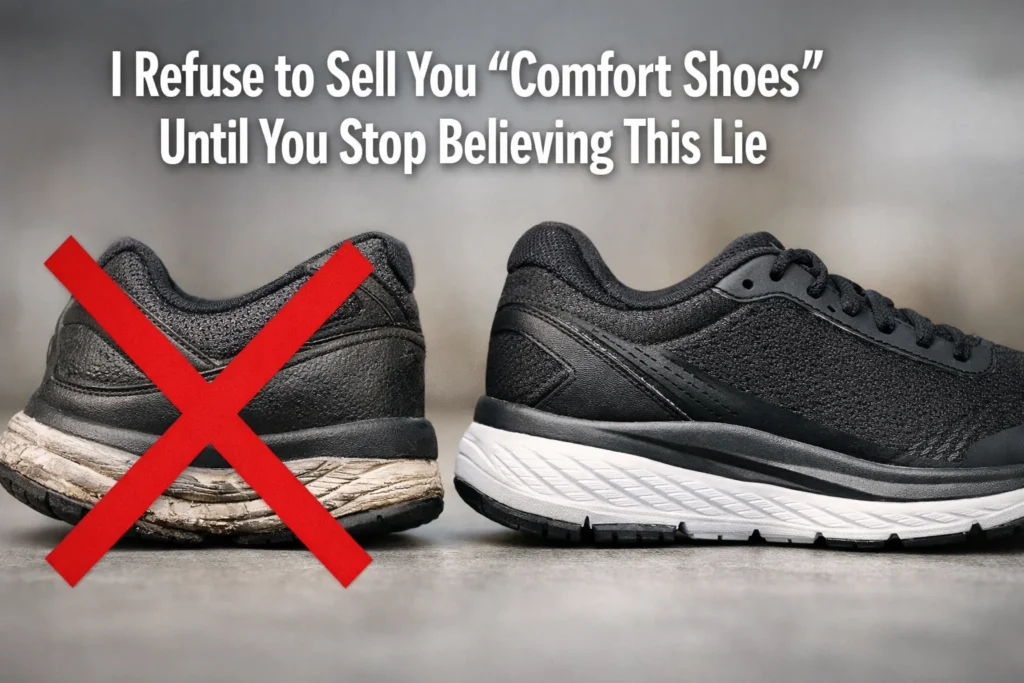
I Refuse to Sell You “Comfort Shoes” Until You Stop Believing This Lie
By Abdul Vahith | Veteran Footwear Specialist
The box hit the counter with a heavy thud.
Inside was a pair of those trendy, ultra-plush “cloud” sneakers that have taken over social media. They looked brand new, but the man standing across from me looked defeated.
“Abdul, I don’t get it,” he said, rubbing his lower back. “The reviews said these were like walking on pillows. I wore them for one shift at the warehouse, and today I can barely stand up.”
I didn’t even need to look inside the shoe. I knew exactly what happened.
I see this scenario in my shop three times a week. It is the single most profitable lie in the footwear industry, and it is costing you hundreds of dollars—and potentially years of chronic pain.
You have been trained to believe that Softness equals Comfort.
I am here to tell you, after 20 years of fitting thousands of feet: That is a lie. And until you stop believing it, I cannot help you.
The Quick Answer (TL;DR)
Stop buying marshmallows. Super-soft, squishy shoes (“cloud” technology) feel amazing for the first 5 minutes in the store, but they offer zero structural support. Over time, your muscles have to work double-time to stabilize your foot in that soft foam, leading to fatigue, knee pain, and plantar fasciitis. True comfort comes from firm support, not squish.
Why You Should Trust Me (And Not A TikTok Influencer)
My name is Abdul Vahith. I don’t unbox shoes for 30 seconds on YouTube. I run a brick-and-mortar shoe store.
I have spent the last two decades on my knees, lacing shoes onto swollen feet, flat feet, and injured feet. I deal with the aftermath. When you buy a bad shoe online, you leave a 1-star review. When you buy a bad shoe from me, you come back to my counter and look me in the eye.
I know the difference between “showroom comfort” (feels good instantly) and “6-hour comfort” (feels good after a long day). They are rarely the same shoe.
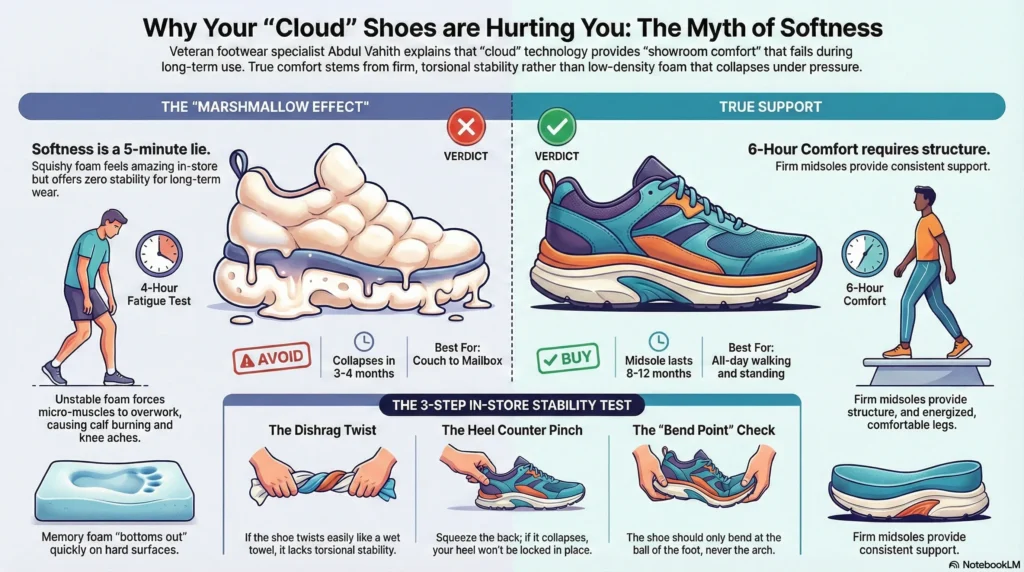
The “Marshmallow Effect”: Why Squishy Fails
Let’s get technical for a second, but I’ll keep it simple.
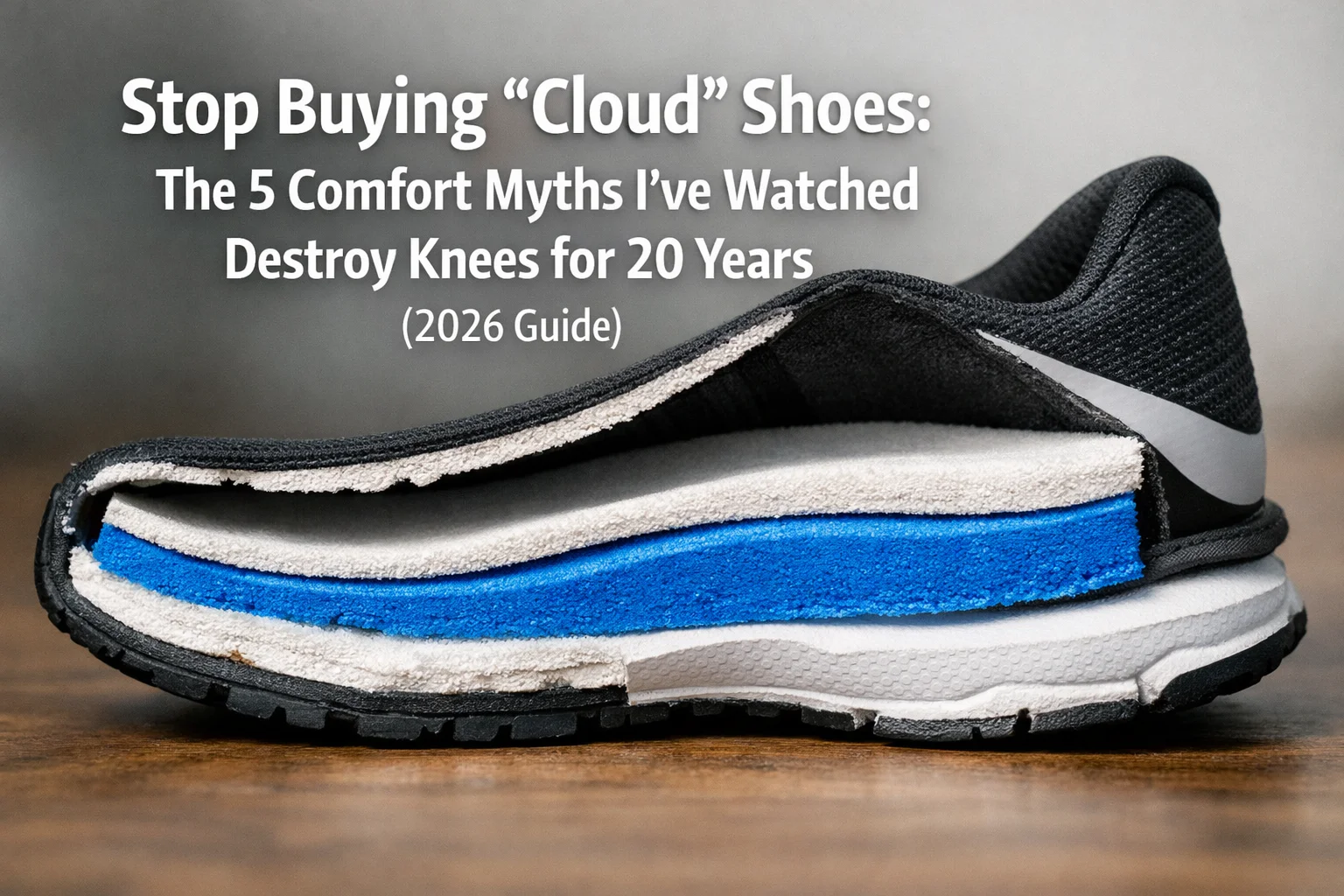
Most of those viral comfort shoes are made of low-density EVA (Ethylene Vinyl Acetate). When you first step in, your foot sinks. Your brain releases a little hit of dopamine. “Ah, soft.”
But here is the Retailer Secret that brands hide in the fine print: Low-density foam collapses.
The 4-Hour Fatigue Test
In my shop, I tell customers to imagine standing on a mattress.
- Minute 1: It feels luxurious.
- Minute 30: Your ankles are wobbling slightly to find balance.
- Hour 4: Your calves are burning, and your knees ache because your foundation is unstable.
That is what your “cloud” shoes are doing. They force your micro-muscles to work overtime just to keep you upright.
By the time you get home, your feet aren’t sore because the shoe was hard; they are sore because the shoe was too soft and your feet ran a marathon inside them just trying to stay stable.
3 Tests I Use In-Store (That You Should Do Now)
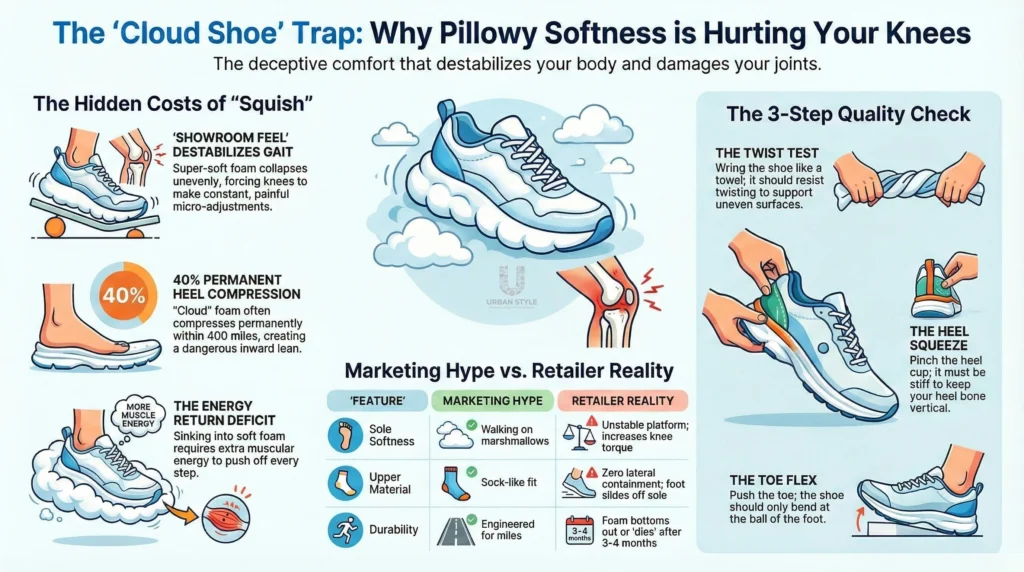
Before I let a customer buy a “comfort” shoe, I put the shoe through hell. If you are shopping right now, do this:
1. The Dishrag Twist
Grab the heel with one hand and the toe with the other. Twist them in opposite directions.
- If it wrings out like a wet towel: Put it back. It has no torsional stability. If the shoe twists that easily, so will your ankle.
- If it resists you: Good. That’s structure.
2. The Heel Counter Pinch
Squeeze the back of the heel (the cup that holds your heel bone) with your thumb and index finger.
- If it collapses instantly: It’s garbage. Your heel will slide around, causing blisters and instability.
- If it stays firm: It will lock your foot in place, allowing the midsole to do its job.
3. The “Bend Point” Check
Push the toe of the shoe against the floor so it bends.
- Correct: It should bend only at the ball of the foot (where your toes bend).
- Fail: If it bends in the middle of the arch, do not buy it. You do not have a joint in the middle of your foot. Your shoe shouldn’t have one either.
Common Regrets I See (Don’t Be This Guy)
I keep a mental log of the “returns of regret.” Here are the top two offenders I see in my store:
The “Vacation Ruiner” A customer buys ultra-soft memory foam slip-ons for a trip to Europe. They walk 15,000 steps on cobblestones. By day 3, they are buying ugly, expensive orthopedic shoes at a German pharmacy because their plantar fascia is screaming.
- Reality: Memory foam bottoms out after 2,000 steps. You were walking on concrete.
The “Standing Desk” Mistake Office workers buy running shoes with massive, squishy heels for standing all day.
- Reality: Running shoes are designed to propel you forward, not support static standing. The pitch tips your pelvis forward, leading to lower back pain.
Comparison: The Lie vs. The Truth
| Feature | The “Comfort” Lie (Squishy Shoes) | The Real Deal (Structured Shoes) |
|---|---|---|
| First Step Feel | “Walking on clouds” (Amazing) | Firm, supportive (Okay) |
| Hour 4 Feel | Dead, flat, unstable | Consistent support |
| Durability | Foam collapses in 3-4 months | Midsole lasts 8-12 months |
| Best For | Couch to Mailbox | All Day Use / Walking |
| My Verdict | AVOID | BUY |
The Controversial Truth About “Breaking In”
I’m going to upset some marketing departments with this one.
If a sneaker requires a “break-in period” of blisters and pain, it doesn’t fit you.
However, if a shoe feels stiff but supportive, that is different. A good pair of boots or high-quality leather shoes will mold to your foot. That is adaptation, not breaking in.
But here is the rule: Structure takes time to love. Softness is a cheap date.
You have to decide if you want a shoe that lies to you about how good it feels for a week, or a shoe that supports your back and knees for a year.
My “Safe Bet” Shopping Guide
I don’t care about brands. I care about construction. But if you came into my store today and asked, “Abdul, what should I buy to save my feet?” this is what I would hand you.
The Criteria:
- Firm Midsole: You shouldn’t be able to compress the side of the sole easily with your thumb.
- Wide Base: Look for a shoe that is slightly wider at the bottom than the upper. This provides a stable platform.
- Removable Insole: This usually indicates the manufacturer put thought into the interior volume.
My Personal Recommendation: Look for “Structured Neutral” or “Stability” categories.
- If you want a sneaker: Look at the New Balance 990 series or Brooks Adrenaline. They aren’t “clouds.” They are chassis for your feet.
- If you want casual: Birkenstock (cork footbeds). They feel like a rock at first. Give it two weeks. You will never go back to foam again.
FAQ (Direct From My Counter)
Why do my feet hurt even in expensive soft shoes? Because the foam collapsed. Once the air bubbles in the foam burst (usually within months), you are walking on flat, dead rubber with no shock absorption.
Is Memory Foam good for feet? No. Memory foam retains heat (sweat) and “remembers” your bad walking habits. If you overpronate, memory foam will mold to that lean and make it worse.
What is the best shoe for standing all day on concrete? A firm running shoe with a low heel drop (difference between heel and toe height) or a clog like Dansko. You need stiffness to bridge the gap between your arch and the concrete.
How often should I replace my shoes? Ignore the calendar. Look at the midsole. If you see deep creases in the foam on the side of the shoe, the support is dead. For daily walkers, this is usually every 6–8 months.
Abdul Vahith has been a footwear retailer for over 20 years. He advocates for foot health over fashion trends. If your feet hurt, check your shoes before you call your doctor.
- The Ultimate Amazon Fashion Find: POYOIOR Cowgirl Western Pattern Embroidered Review
- 7 Best Safety Shoes for Construction Workersin India
- 7 Best Safety Shoes for Construction Workers in India 2026
- 5 Best Orthopedic Slippers for Diabetic Patients in India (2026 Guide)
- What is TPR Sole? The Ultimate Guide to Durable Shoe Soles (2026)