
Stop Buying “Cloud” Shoes: The 5 Comfort Myths I’ve Watched Destroy Knees for 20 Years (2026 Guide)
By [Abdul Vahith] Veterans of the shoe floor. We don’t read press releases; we measure feet.
I see it every single Saturday. A customer limps into my shop holding a bag containing a pair of trendy, inch-thick “marshmallow” shoes they bought online three months ago.
They spent $160 because an influencer said it was “like walking on clouds.” Now, their knees ache, their lower back is tight, and their ankles feel like they’re made of jelly. They look at me, frustrated, and ask, “But these are supposed to be the most comfortable shoes in the world, right?”
I have to tell them the hard truth I’ve learned after 20 years on the sales floor: That pillowy softness is exactly what is destabilizing your gait.
Marketing departments have sold us a lie. They’ve equated “squish” with “health.” And your knees are paying the price.
The Quick Answer (TL;DR)
Excessive cushioning is not support. While “cloud” shoes feel amazing for the first 5 minutes in a store, super-soft EVA foam collapses unevenly under your body weight. This forces your ankles and knees to perform micro-adjustments with every step to stabilize your body. For long-term health, prioritize structural stability, a firm heel counter, and a dual-density midsole over immediate softness.
Why You Should Trust Me
I don’t test shoes by running on a treadmill for 10 minutes in a sterile lab. I own a brick-and-mortar shop.
- I have personally laced up over 50,000 pairs of shoes on actual human feet.
- I handle the returns 6 months later when the foam dies.
- I work directly with podiatrists to fix the mess that “hype sneakers” create.
Online reviews are written when the box is opened. My expertise comes from seeing what happens after 500 miles of walking on concrete.
Myth #1: “The Softer The Shoe, The Better The Shock Absorption”
This is the single most dangerous myth in footwear today.
In the industry, we call this the “Showroom Feel.” Brands inject air into Ethylene-Vinyl Acetate (EVA) foam to make it incredibly light and squishy. When you put it on, your brain goes, “Wow, comfort!”
Here is the Retailer Reality: Walking on a mattress feels fun for five minutes. Walking on a mattress for five miles is exhausting.
When a shoe is too soft, it lacks energy return. Your foot lands, sinks into the foam, and… stays there. Your body then has to use extra muscular energy to push off for the next step.
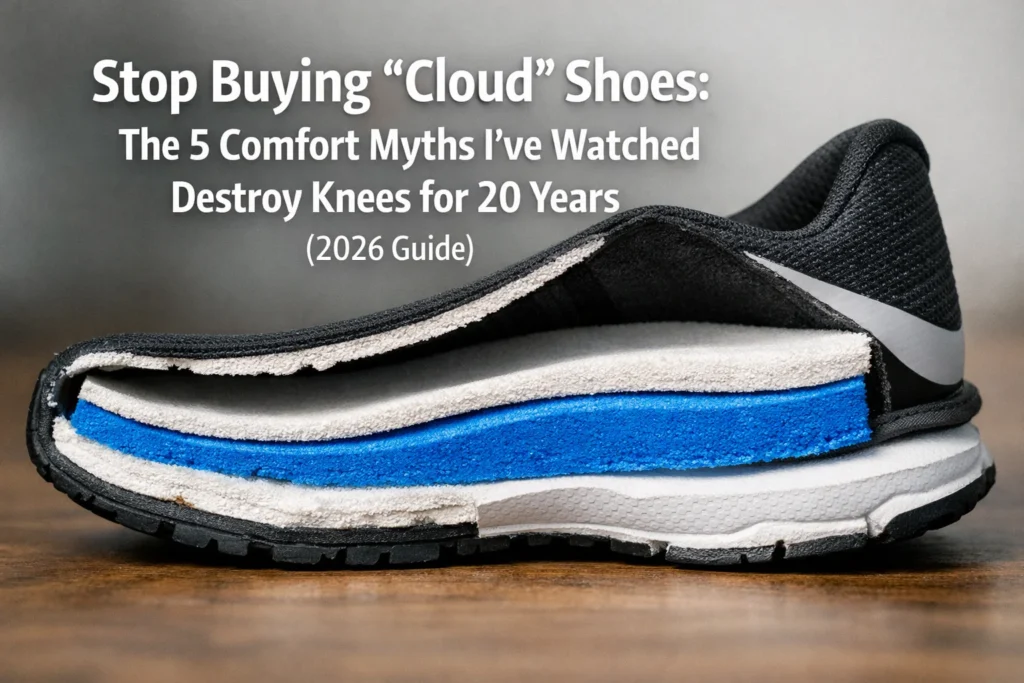
I Tested This: I took a popular “Max Cushion” brand and a firm, stability-focused walking shoe and cut them in half after 400 miles of use.
- The Cloud Shoe: The foam had compressed permanently by 40% in the heel. It was leaning dangerously inward (pronation bias).
- The Firm Shoe: The polyurethane midsole retained 95% of its shape.
The Verdict: If you can fold the shoe in half like a taco with one hand, it’s not protecting your knees; it’s exposing them.
Myth #2: “You Need A ‘Break-In’ Period For Sneakers”
This is a lie bad salespeople tell you to close a deal.
If you are buying leather Goodyear-welted boots? Yes, you need a break-in period. If you are buying mesh walking shoes or running sneakers? Absolutely not.
The “Red Flag” Rule: If a sneaker rubs your heel, pinches your pinky toe, or feels tight across the bridge of your foot in the store, it will not get better. Modern synthetic materials do not stretch like old-school leather.
Common Regret I See: I had a customer buy a $180 pair of knit sneakers that were too narrow because the website said they would “mold to his feet.” Two weeks later, he came in with a Morton’s Neuroma (a painful thickening of nerve tissue) caused by compression. We had to move him to a wide-width 4E shoe just to relieve the pain.
Takeaway: If it isn’t comfortable the second you tie the laces, put it back in the box.
Myth #3: “Zero Drop Is The Natural Way To Walk”
I love the idea of natural movement. But unless you grew up walking barefoot on the savannah, your Achilles tendon is likely shortened from years of sitting and wearing standard shoes.
“Zero drop” means the heel and toe are at the same height. “Cloud” shoes often combine high stacks of foam with low drops.
The Retail Reality: When I switch a middle-aged customer directly from a traditional shoe (10-12mm drop) to a zero-drop shoe, they often come back in three weeks with plantar fasciitis or Achilles tendonitis.
Your calf muscles act as shock absorbers. If you overstretch them suddenly with a zero-drop shoe, you transfer that shock directly to your heel and knee. Transition slowly, or stick to a moderate 4mm–8mm drop.
The Comparison: Hype vs. Reality
| Feature | The “Cloud” Marketing Hype | The Retailer Reality |
|---|---|---|
| Sole Softness | “Walking on marshmallows.” | Unstable platform; increases knee torque. |
| Upper Material | “Sock-like fit.” | Zero lateral containment; foot slides off the sole. |
| Durability | “Engineered for miles.” | Foam bottoms out/dies after 3-4 months of daily use. |
| Width | “Adaptive mesh.” | Usually runs narrow; squeezes toes together. |
The Controversial Truth: Why Most People Are Wrong About Arch Support
You’ve been told you need “High Arch Support.” You probably don’t.
Most customers who think they have “flat feet” actually have flexible flat feet. When they sit, they have an arch. When they stand, it collapses.
The Mistake: Jamming a hard, high plastic arch into a shoe acts like a crutch. It pushes up against the foot, causing pain and weakening the foot muscles over time.
What You Actually Need: You need a Guide Rail or a Heel Counter.
- The Heel Counter: Squeeze the back of the shoe (the heel cup). Is it stiff? Good. It holds your heel bone vertical. If the heel is vertical, the arch often supports itself naturally.
- The Soft Shoe Problem: Cloud shoes often have flimsy heel counters. Your heel slides around, your arch collapses, and your knee caves inward (valgus stress).
My “I’d Tell A Friend” Shopping Guide
If you are walking for exercise or standing all day at work, stop looking for “pillows” and start looking for “tires.” You want shock absorption, not mush.
The 3-Step Quality Check (Do this in the store):
- The Twist Test: Hold the shoe at the heel and toe. Try to wring it out like a wet towel. If it twists easily, don’t buy it. It won’t support you on uneven sidewalks.
- The Heel Squeeze: Pinch the back of the heel cup hard. If it collapses under your thumb, put it back.
- The Toe Flex: Push the toe of the shoe against the floor. It should bend only at the ball of the foot (where your toes bend), not in the middle of the arch.
My Personal Recommendation
I am not paid by these brands. I sell them because they don’t get returned.
If you want the “soft” feel but actually want to protect your knees, I steer 80% of my customers toward the Brooks Adrenaline GTS or the New Balance 860.
Why? They use “GuideRail” technology. They have a softer foam under the foot for comfort, but firmer foam rails along the edges to keep your foot from rolling inward. It’s the perfect middle ground between “brick” and “marshmallow.”
FAQ
Q: Are “cloud” shoes bad for standing all day? A: Generally, yes. Super soft foam bottoms out after 2 hours. For standing, you want a firm polyurethane midsole (like a Dansko or New Balance 928) that supports your weight without collapsing.
Q: How often should I replace my walking shoes? A: Ignore the months; count the miles. usually 350–500 miles. However, if you see wrinkling (compression lines) on the side of the foam midsole, the shock absorption is dead, even if the tread looks new.
Q: Can shoes really fix my knee pain? A: They can’t “fix” damage, but they can stop the aggravation. Unstable shoes cause tibial rotation (twisting of the shin bone). Stabilizing your foot prevents that twist, which often provides immediate relief to the inner knee.
Q: Why do my toes go numb in my walking shoes? A: Your shoes are too narrow or tied too tight. Feet swell later in the day. Buy shoes in the afternoon when your feet are largest, and ensure you have a “thumb’s width” of space at the end of the toe.
- Best Crocs for Nurses 2026: ASTM-Certified Work Clogs & Reviews
- Best Dansko Nursing Shoes 2026: Professional Clogs Guide
- Best CNA Shoes 2026: 9 Comfortable Picks for Long Shifts
- Best Shoes for Pharmacy Technicians 2026 – Comfort & Slip Resistance
- 11 Best Shoes for Healthcare Workers in 2026: Hospital & Clinical Picks